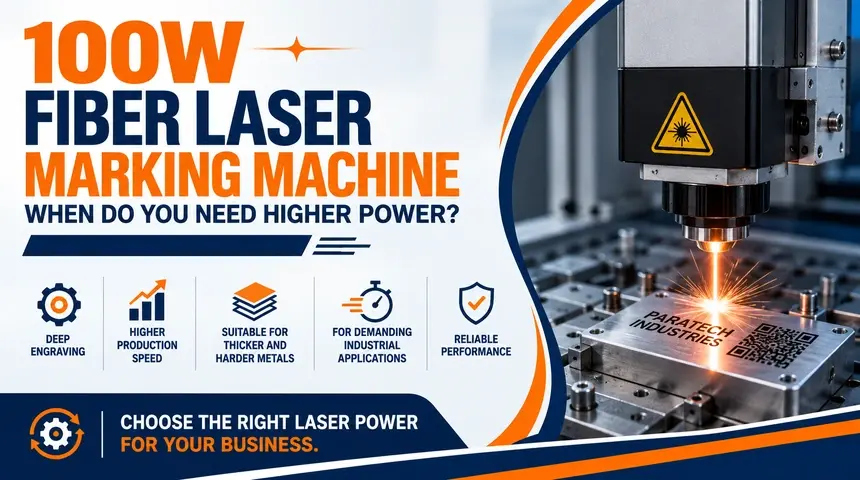
100W Fiber Laser Marking Machine: When Do You Need Higher Power?
Introduction
Choosing the right laser power is one of the most important decisions when investing in a fiber laser marking machine. While 20W, 30W, 50W, and 60W machines can handle many standard marking applications, some manufacturers need more power for deeper engraving, faster production, or demanding industrial workloads. This is where a 100W fiber laser marking machine becomes relevant.
A 100W machine does not automatically produce better results for every application. Its main advantage is the additional energy available for material removal, deeper engraving, and demanding production cycles. Industry guidance published in 2026 describes 100W fiber lasers as particularly useful for relief or 3D work, high-volume depth, and applications where deeper processing is required.
The right choice depends on your material, required engraving depth, production volume, cycle time, marking area, and overall application. This guide explains when higher laser power makes practical sense and when a lower-power machine may already be sufficient.
What Is a 100W Fiber Laser Marking Machine?
A 100W fiber laser marking machine is a high-power laser marking system designed for permanent marking, engraving, and material removal on suitable materials. Compared with lower-power systems, it can deliver more laser energy to the workpiece, which can help reduce the number of passes required for deeper engraving and demanding applications.
A 100W fiber laser can be used for applications such as industrial component identification, serial numbers, QR codes, barcodes, logos, deep engraving, tooling, moulds, and other metal-processing requirements. However, the actual performance depends on the laser source, optics, pulse characteristics, material, artwork, focus, and machine configuration.
Paratech Industries offers fiber laser marking configurations from 20W to 100W. Its published specifications include a 1064 nm wavelength, working areas ranging from 100 × 100 mm to 300 × 300 mm, power adjustment from 1–100%, and maximum linear speed up to 12,000 mm/s.
When Do You Need 100W Laser Power?
The most important question is not whether 100W is more powerful, but whether your production process actually needs that additional power. A 100W machine becomes more relevant when your existing laser takes too many passes, struggles to achieve the required depth, or has become a bottleneck in production.
For standard serial numbers, logos, QR codes, and product identification marks, a lower-power fiber laser may already provide the required result. However, when the application involves significant material removal or deeper engraving, higher power can reduce processing time.
According to current fiber laser power guidance, the additional power primarily improves processing speed and engraving depth rather than suddenly making completely different metals markable.
You Need Deep Metal Engraving
Deep engraving is one of the clearest reasons to consider 100W. Standard surface marking removes a relatively small amount of material, while deep engraving requires repeated material removal.
A 100W system can provide greater material-removal capability, which can help reduce the number of passes required for demanding engraving jobs. This can be useful for tooling, moulds, dies, industrial components, nameplates, and other parts where the mark needs to remain visible even after wear or surface treatment.
The exact achievable depth cannot be determined from wattage alone. Material hardness, laser source, pulse settings, focus, scan speed, frequency, lens selection, and the desired surface finish all affect the result.
Your Production Volume Is High
Production volume is another major reason manufacturers move toward higher laser power. If hundreds or thousands of components need to be marked every day, even a small reduction in cycle time can affect total production capacity.
For example, if a particular deep engraving job requires multiple passes on a lower-power machine, a 100W system may reduce the processing time by allowing more material to be removed during each pass.
However, the laser is only one part of the production cycle. Loading, positioning, fixture setup, inspection, and unloading also consume time. If those processes take longer than laser processing, increasing laser power alone may not produce a major improvement in total throughput.
Your Laser Has Become a Production Bottleneck
A higher-power machine becomes especially useful when the laser marking stage is slowing down the rest of the production line.
Imagine a manufacturing line where components are produced continuously, but the marking process takes significantly longer than machining or assembly. In that situation, improving marking speed can help balance the overall workflow.
Industrial 100W systems are commonly positioned for high-volume production and applications where marking speed directly affects production efficiency.
Before upgrading, measure your current cycle time. Determine how long the laser actually spends marking each component and compare that with handling and inspection time.
You Mark Large or Heavy Industrial Components
Large industrial components can require larger marking areas, longer engraving paths, or multiple sections to be processed. When the marking job involves substantial material removal, additional power can become useful.
Paratech Industries provides multiple working-area configurations, including 100 × 100 mm, 175 × 175 mm, 250 × 250 mm, and 300 × 300 mm, with customized configurations available.
The working area should therefore be evaluated together with laser power. A 100W machine with the right lens and configuration may be more suitable for a large industrial marking application than simply choosing a higher wattage without considering the complete system.
You Need Fewer Passes for Engraving
Deep engraving often requires multiple passes. Each additional pass increases processing time.
Higher laser power can increase material removal per pass when the material and process parameters allow it. This is particularly useful when engraving recessed text, numbers, logos, patterns, or relief designs into metal.
The goal should not be to use maximum power at all times. Instead, the machine should be configured to achieve the required depth, contrast, edge quality, and repeatability efficiently.
You Are Planning Future Production Expansion
Businesses sometimes purchase equipment based only on today's workload and then find that the machine becomes limiting when production increases.
If your business expects higher production volumes or more demanding engraving work in the future, a 100W system can provide additional processing capacity. This can be useful when the expected workload includes deeper engraving, larger batches, or more complex industrial components.
However, future expansion should be based on a realistic production plan. Buying substantially more power than your application requires can increase the initial investment without providing an immediate production benefit.
You Need Specialized Industrial Applications
A 100W fiber laser can be considered for demanding industrial applications involving tooling, moulds, dies, heavy components, and deep identification marks. Some 100W systems are also configured for specialized processes such as relief engraving and 3D work.
For applications involving different materials or processes, machine selection should be based on actual sample testing rather than wattage alone.
100W Fiber Laser vs Lower-Power Machines
A 100W machine is not necessarily the right choice for every manufacturer. If your primary requirements are serial numbers, barcodes, QR codes, logos, and basic identification marks, a lower-power fiber laser may already meet your requirements.
The higher-power option becomes more relevant when depth, production speed, material removal, or high-volume processing becomes a significant requirement.
| Requirement | Lower Power | 100W Fiber Laser |
|---|---|---|
| Surface marking | Suitable | Suitable |
| QR codes and serial numbers | Suitable | Suitable |
| Standard metal engraving | Suitable | Suitable |
| Deep engraving | Application dependent | Better suited |
| High material removal | Limited compared with 100W | More suitable |
| High-volume demanding work | Application dependent | More suitable |
| Production bottleneck | May require longer cycles | Can provide additional capacity |
The actual result will always depend on the material and machine configuration.
Consider the Complete Machine, Not Just Wattage
Laser power is only one part of a fiber laser marking system. Buyers should also evaluate the laser source, marking lens, galvo scanner, working area, software, cooling system, fixture, rotary attachment, automation options, safety enclosure, warranty, installation, and after-sales support.
Paratech Industries provides industrial laser solutions across marking, cutting, engraving, welding, soldering, and cleaning applications and has been manufacturing laser machines since 2014.
If your application requires a specialized working setup, automation, customized fixtures, or other application-specific requirements, a Customise Laser Machine can be considered.
For standard metal identification and engraving requirements, explore the Fiber Laser Marking Machine.
When your requirement moves beyond marking into sheet and metal cutting, a Fiber Laser Cutting Machine is designed for cutting applications. Paratech's fiber laser cutting systems are available across a 500W to 5KW range and are designed for industrial sheet-metal processing.
How to Know If You Really Need 100W
Before purchasing, test your actual component. Provide the supplier with the material, artwork, required depth, target cycle time, and expected production quantity.
Compare the 50W or 60W result with the 100W result. Check engraving depth, number of passes, processing time, surface quality, heat effects, consistency, and overall production requirements.
This sample-testing approach gives you a practical basis for determining whether the additional power solves a real production problem.
Conclusion
A 100W fiber laser marking machine makes sense when your business needs deeper engraving, greater material removal, shorter processing cycles, or higher production capacity. It is not simply a better version of a lower-power machine. The right power depends on your actual material, marking depth, production volume, cycle time, and application.
If higher power solves a measurable production requirement, 100W can provide useful additional capacity. If your work mainly involves standard surface marking, a lower-power configuration may already be sufficient.
FAQs
Is 100W good for deep engraving?
Yes. Higher power can provide greater material-removal capability for demanding deep-engraving applications.
Is 100W faster than 50W?
It can provide faster processing for suitable demanding applications, but actual speed depends on material, artwork, depth, and machine parameters.
Do I need 100W for QR codes?
Usually not. Basic QR codes and serial numbers can often be handled by lower-power fiber laser systems.
Can 100W mark stainless steel?
Yes. Fiber lasers are widely used for marking stainless steel, although the required power depends on the desired marking type and production requirements.
Should I upgrade from 50W to 100W?
Consider the upgrade when your current machine cannot achieve the required depth or cycle time efficiently. Test both configurations using your actual production component before deciding.