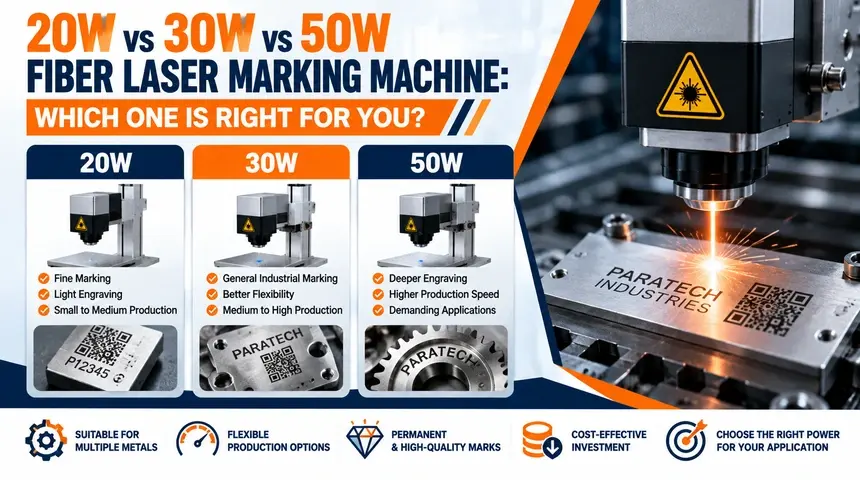
20W vs 30W vs 50W Fiber Laser Marking Machine: Which One Is Right for You?
Introduction
Choosing between a 20W, 30W, and 50W fiber laser marking machine can make a significant difference to your production speed, marking quality, and overall investment. Although all three machines use fiber laser technology, their performance can vary depending on the material, marking depth, design, and daily production requirements.
For businesses working with stainless steel, aluminium, brass, copper, jewellery, and other metals, selecting the right laser power is essential. A higher-wattage machine is not automatically the right choice for every application. The best option is the one that meets your marking requirements while maintaining consistent quality and reasonable operating costs.
Paratech Industries offers fiber laser marking solutions for different industrial applications. Understanding the differences between 20W, 30W, and 50W systems can help you make a more informed decision before requesting a machine quotation.
What Is a 20W Fiber Laser Marking Machine?
A 20W fiber laser marking machine is generally used for fine marking and light engraving on suitable metal surfaces. It is a practical option for businesses that need to mark product names, serial numbers, logos, QR codes, barcodes, and identification details on individual components.
For small workshops, jewellery manufacturers, tool manufacturers, and businesses with moderate marking requirements, a 20W system can handle many everyday applications. It is particularly useful when the main objective is producing clear, permanent marks rather than removing a large amount of material.
The actual marking result depends on the metal, surface finish, focal position, marking speed, frequency, and number of passes. Deep engraving or high-volume production may require more processing time, so businesses should test their samples before choosing a 20W machine.
What Is a 30W Fiber Laser Marking Machine?
A 30W fiber laser marking machine offers a higher power output than a 20W system and provides additional flexibility for industrial marking applications. It can be considered when a business needs a balance between marking quality, production speed, and engraving capability.
For example, manufacturers working with stainless steel components, aluminium parts, brass products, machine components, and metal nameplates may consider a 30W system for regular production. It can also be suitable for businesses that mark different types of products and need more flexibility than a basic marking setup.
A 30W machine does not automatically produce marks that are 50% faster than a 20W machine. Actual speed depends on the material, design, required depth, laser parameters, and machine configuration. However, additional available power can provide more processing flexibility when the application requires it.
What Is a 50W Fiber Laser Marking Machine?
A 50W fiber laser marking machine is worth considering when production requirements involve more demanding marking applications, deeper engraving, or higher output targets. Its greater laser power can help deliver more energy to the workpiece, potentially reducing processing time for suitable applications.
Industrial manufacturers, metal component producers, automotive suppliers, and businesses handling larger batches may benefit from evaluating a 50W system. It can also be useful when the same machine needs to handle both standard identification marks and more demanding engraving jobs.
However, a 50W machine is not necessarily required for every industrial application. If the main requirement is marking small serial numbers or simple logos on suitable metal surfaces, a lower-power system may already meet the production target.
Before selecting a 50W machine, confirm that the additional power will improve your actual production process enough to justify the higher initial investment.
20W vs 30W vs 50W Fiber Laser Marking Machine: Key Differences
The following comparison explains the general differences between these three power options. Actual performance varies by laser source, material, machine configuration, and marking parameters.
| Feature | 20W | 30W | 50W |
|---|---|---|---|
| Main use | Fine, routine marking | General industrial marking | More demanding marking and engraving |
| Production requirements | Light to moderate | Moderate to higher | Higher or more demanding workloads |
| Engraving capability | Suitable for light engraving | Greater processing flexibility | More suitable for deeper engraving applications |
| Typical applications | Small metal parts, jewellery, serial numbers | Components, nameplates, industrial parts | Industrial parts, larger batches, demanding engraving |
| Investment | Usually lower | Mid-range option | Usually higher |
Paratech Industries lists fiber laser marking configurations of 20W, 30W, and 50W, with marking areas and machine configurations that can vary according to requirements. Its marketplace listings also describe air-cooled systems, EZCAD control, and marking-area options.
The table should be treated as a general selection guide rather than a guarantee of specific marking speeds or engraving depths. The final result depends on the complete machine and the application being processed.
Which Laser Power Is Better for Different Materials?
Material selection is just as important as laser power. Fiber lasers are widely used for metal marking, including stainless steel, mild steel, aluminium, brass, copper, titanium, carbide, and suitable jewellery metals.
For stainless steel components requiring serial numbers, logos, or product identification, a 20W or 30W machine may be sufficient for many applications. If the job involves deeper engraving, larger batches, or more demanding processing requirements, a 50W system may be worth testing.
For aluminium and brass, the surface finish, coating, and desired contrast can affect the result. Anodized aluminium, for example, may require different settings from untreated aluminium. Similarly, marking gold and silver jewellery requires careful parameter selection to achieve the desired finish without damaging delicate details.
Businesses should not select a machine based only on a list of compatible materials. Testing actual samples is important because different grades, coatings, and surface treatments can respond differently to laser energy.
For applications involving plastics, glass, PCB materials, or other heat-sensitive surfaces, a UV Laser Marking Machine may be worth considering instead of assuming that a higher-power fiber laser will deliver the required result.
Which Machine Is Better for Your Business?
The right choice depends on what your business produces, how many parts you mark daily, and the quality you expect from each marking cycle.
A 20W machine can be a suitable starting point for small workshops and businesses handling routine marking jobs. If your work mainly involves product identification, simple logos, and fine markings on suitable metals, there may be little benefit in purchasing more power than your application needs.
A 30W machine can be considered when your business handles a wider variety of metal components or needs additional flexibility for regular production. It provides a middle option for manufacturers who want to balance initial investment with marking performance.
A 50W machine is worth evaluating when deeper engraving, demanding production schedules, or more challenging marking applications are part of your daily operations. Before investing, compare the cycle time and marking quality of all three options using the same sample and required output.
If you need marking on products moving through a manufacturing or packaging line, consider an Online Laser Marking Machine. For larger components, specialized fixtures, or unusual working areas, a Custom Laser Machine may be more appropriate than a standard machine.
Factors to Check Before Buying
Laser power is only one part of a fiber laser marking machine. Buyers should also evaluate the marking area, laser source, control software, lens, working distance, cooling system, and overall machine construction.
A standard marking area may be sufficient for small components, but larger products or multiple parts in one setup may require a different lens or working area. Paratech Industries lists marking-area options ranging from smaller fields to configurations of up to 300 × 300 mm, depending on the machine.
The laser source and its stability should also be considered. Ask the supplier about the source manufacturer, warranty, expected service life, availability of replacement parts, and after-sales support. Confirm that the machine includes the required software, installation, training, and safety equipment.
Most importantly, request a sample test. Provide the manufacturer with your actual material, artwork, desired marking depth, and expected production quantity. This makes it easier to compare a 20W, 30W, and 50W machine under similar conditions.
What About the Price Difference?
The purchase price generally increases with power and configuration, but there is no universal price difference between 20W, 30W, and 50W machines. Laser source, working area, lens, automation, accessories, and installation requirements can all affect the final quotation.
For example, a 20W machine with a larger marking area or specialized fixture may cost more than a basic 30W configuration from another supplier. Similarly, a 50W machine designed for a particular production process may include components that affect the overall investment.
Paratech Industries has published marketplace listings for fiber laser marking machines with 20W, 30W, and 50W options. One listing shows an approximate base price of ₹1,40,000 before 18% GST, but this should not be treated as a confirmed current price for every power configuration.
When requesting a quotation, ask for an itemized breakdown covering the machine, GST, delivery, installation, training, accessories, warranty, and any customization. Compare quotations with matching specifications rather than choosing a supplier solely on the advertised starting price.
Conclusion
A 20W fiber laser marking machine can meet many routine marking needs, a 30W system offers additional flexibility for general industrial work, and a 50W machine may suit more demanding engraving and production requirements. The right choice depends on your material, marking quality, daily workload, and budget.
Test your samples, compare the complete machine specifications, and choose the power that meets your production goals. Explore Paratech Industries for fiber laser marking, customized laser systems, online marking, and industrial laser solutions.
FAQs
What is the difference between 20W, 30W, and 50W fiber laser marking machines?
The main difference is laser output power, which affects processing flexibility, engraving capability, and potential marking speed.
Is a 20W fiber laser marking machine suitable for business?
Yes. It can handle many routine marking applications, including serial numbers, logos, and identification marks on suitable metals.
Is a 50W fiber laser better than a 30W machine?
A 50W machine offers more available power, but the better choice depends on your material, marking requirements, and production targets.
Which fiber laser power is suitable for stainless steel?
20W, 30W, and 50W systems can all mark stainless steel. The right power depends on the desired contrast, depth, and production speed.
Does a higher-wattage fiber laser cost more?
Generally, higher-power configurations cost more, although the laser source, working area, accessories, and automation also affect the price.