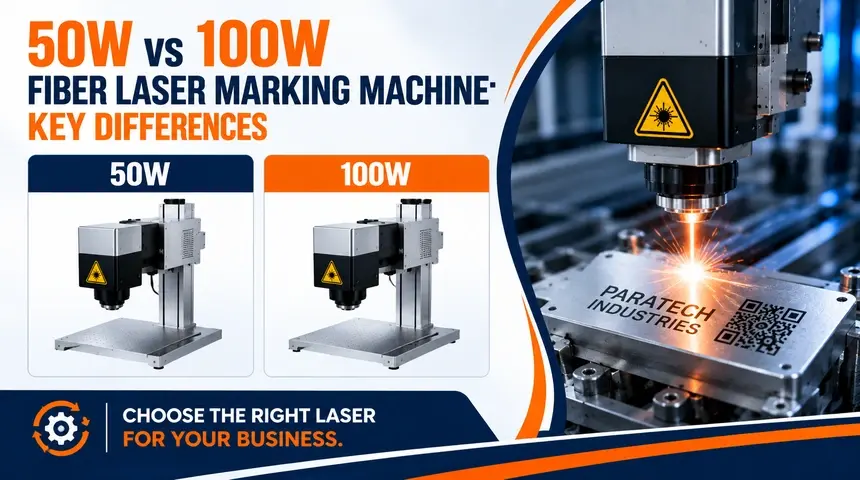
50W vs 100W Fiber Laser Marking Machine: Key Differences
Introduction
Choosing between a 50W and 100W fiber laser marking machine is an important decision for manufacturers that need consistent metal marking, engraving, and production performance. Both machines use fiber laser technology, but the higher power of a 100W system can change how quickly material is removed and how suitable the machine is for demanding engraving or high-volume work. A 50W machine can already handle many industrial marking applications, so moving to 100W should be based on an actual production requirement rather than simply choosing the higher number.
The right machine depends on the material, marking depth, cycle time, production volume, working area, and type of finish required. Understanding these differences can help businesses compare the two options more realistically before requesting a quotation.
What Is a 50W Fiber Laser Marking Machine?
A 50W fiber laser marking machine is designed for demanding industrial marking and engraving applications. It can produce permanent marks such as serial numbers, QR codes, barcodes, logos, product identification details, and traceability codes on suitable metals. Higher power than entry-level systems can also provide greater flexibility for deeper engraving and shorter processing times.
A 50W system can be useful for stainless steel, aluminium, brass, copper, titanium, carbide, and suitable jewellery materials. Paratech Industries’ Fiber Laser Marking Machine offers 50W configurations within its fiber laser marking range. The product page lists a 1064 nm wavelength, working areas from 100 × 100 mm to 300 × 300 mm, and customized options.
What Is a 100W Fiber Laser Marking Machine?
A 100W fiber laser marking machine provides substantially higher available laser power and is intended for applications where deeper material removal, higher throughput, or demanding engraving is required. Higher power does not automatically make every marking job better. For simple identification marks that a lower-power system can complete within the required cycle time, the additional power may provide little practical benefit.
Industry guidance from KEYENCE notes that 100W fiber lasers are generally used for thick metals requiring deep engraving or cutting, while higher wattage can be unnecessary for ordinary tracking and traceability marking when lower power already meets the production requirement.
50W vs 100W: Main Difference
The most important difference is available laser power. A 100W source has twice the nominal power of a 50W source, but that does not mean every job will be completed in half the time. Actual processing speed depends on material, artwork, fill area, depth, focus, pulse settings, scan speed, and machine configuration.
The practical advantage of 100W becomes more noticeable when the application involves deeper engraving or substantial material removal. Industry sources describe 50W systems as suitable for faster production and deeper engraving, while 100W systems are used for deeper processing and higher-throughput industrial work.
Marking Speed and Production Throughput
Production speed is one of the main reasons a manufacturer may consider moving from 50W to 100W. If the laser is the bottleneck in a production cell, additional power can reduce the time required for demanding marks, particularly when a large filled area or deeper engraving is involved.
However, the total production cycle includes loading, positioning, marking, inspection, and unloading. If handling or inspection takes longer than the laser process, a 100W machine may not significantly improve overall throughput. Before upgrading, measure the complete cycle time and identify whether laser processing is actually limiting production.
Deep Engraving Capability
For deeper engraving, the difference between 50W and 100W becomes more relevant. A 50W fiber laser can handle many engraving applications and is suitable for industrial parts, tools, hardware, and other metal components. A 100W system can provide greater material-removal capability and may reduce the number of passes required for demanding engraving work.
This can be useful for moulds, dies, heavy metal components, tooling, and applications where a recessed or deeper mark is required. Still, engraving depth is not determined by wattage alone. Material hardness, focal conditions, scan strategy, frequency, pulse duration, and the desired finish all influence the final result.
Materials and Applications
Both 50W and 100W fiber laser marking machines can be used for many of the same metal materials. Paratech Industries lists stainless steel, mild steel, aluminium, brass, copper, titanium, cast iron, carbide, gold, silver, platinum, and other suitable materials for its fiber laser marking machines.
A 50W machine may be suitable for product identification, serial numbers, QR codes, logos, nameplates, and general industrial engraving. A 100W machine becomes more relevant when the same business needs faster processing, deeper engraving, or heavier material removal.
The material should always be tested before purchasing because different alloys, coatings, thicknesses, and surface finishes can respond differently to laser energy.
Heat and Marking Quality
More power also means that process parameters become increasingly important. A higher-power laser can deliver more energy to the workpiece, so unsuitable settings may cause excessive heat, over-burning, discoloration, or unwanted surface effects. KEYENCE notes that higher wattage can be counterproductive when a lower-power system already produces the required mark.
For standard marking, the objective is often not maximum power but the required contrast, clarity, permanence, and repeatability. A 50W system can therefore be a better fit for applications where controlled surface marking is more important than aggressive material removal. A 100W system should be evaluated when its additional power solves a specific production or engraving requirement.
Working Area and Machine Configuration
Power is only one specification to compare. Buyers should also consider the working area, laser source, lens, software, marking speed, fixture, automation, and overall machine design.
Paratech Industries offers working areas of 100 × 100 mm, 175 × 175 mm, 250 × 250 mm, and 300 × 300 mm, along with customized configurations. Its published fiber laser marking specifications include a 1064 nm wavelength, power adjustment from 1–100%, and maximum linear speed up to 12,000 mm/s.
These specifications show why two machines with the same wattage can still have different practical capabilities. The complete machine configuration should be evaluated rather than comparing laser power alone.
Cost and Return on Investment
A 100W fiber laser marking machine will generally require a higher investment than a 50W configuration, but the exact difference depends on the laser source, marking area, optics, automation, enclosure, accessories, and other specifications.
The important question is whether the additional investment creates measurable production value. If a 100W machine reduces cycle time, decreases the number of passes, or allows the business to accept larger engraving jobs, the higher capital cost may be easier to justify. If most jobs are simple serial numbers and logos, a 50W system may already provide sufficient capability.
Which One Should You Choose?
A 50W fiber laser marking machine can be considered when you need a balance between industrial marking, engraving flexibility, production speed, and investment. It is suitable for many metal marking and engraving applications and can support a wide range of industrial components.
A 100W machine should be considered when deeper engraving, high material removal, or high production throughput is a central requirement. It can be useful for demanding industrial applications where the laser process is a significant part of the production cycle.
Before making the decision, test your actual material and artwork on both power levels if possible. Compare mark quality, cycle time, engraving depth, number of passes, heat effects, and total production requirements rather than comparing wattage alone.
When a business needs online production marking, an Online Laser Marking Machine can integrate marking into a moving production or packaging line. For specialized working areas, fixtures, or automation requirements, a Custom Laser Machine may also be considered.
Buying Checklist
Before selecting a 50W or 100W fiber laser marking machine, check the material and surface finish, required marking depth, daily production quantity, target cycle time, working area, lens requirements, laser source, software, cooling, safety arrangements, warranty, installation, training, and after-sales support.
Most importantly, request a sample test. A supplier should be able to demonstrate the expected result on your actual component. This gives you a practical basis for comparing 50W and 100W systems.
Conclusion
The choice between 50W and 100W should be based on production requirements rather than wattage alone. A 50W machine can handle many industrial marking and engraving jobs, while 100W provides additional power for deeper engraving, higher material removal, and demanding production workloads. Evaluate your material, depth, cycle time, quality requirements, and complete machine configuration before making the investment.
FAQs
What is the main difference between 50W and 100W fiber lasers?
The main difference is available laser power, which can affect material removal, engraving depth, and processing time.
Is 100W faster than 50W?
It can be faster for suitable demanding applications, but actual speed depends on material, design, depth, and machine parameters.
Is 50W enough for metal marking?
Yes. A 50W fiber laser can handle many industrial metal marking and engraving applications.
Is 100W better for deep engraving?
Higher power can provide greater material-removal capability, making 100W useful for demanding deep-engraving applications.
Should I choose 50W or 100W?
Compare your actual sample, required depth, production volume, and cycle time. Choose the configuration that meets those requirements.