
A Complete Guide to Choosing a UV Laser Machine
Introduction
When it comes to purchasing a UV laser marking machine, power, speed, software, and automation variability is what makes picking the right machine so important. Understanding each of these options and how they relate to your business can help save costs and ensure your purchase meets your needs. This article helps identify and understand the considerations needed for purchasing a UV laser marking machine for your business.
What Is a UV Laser Marking Machine?
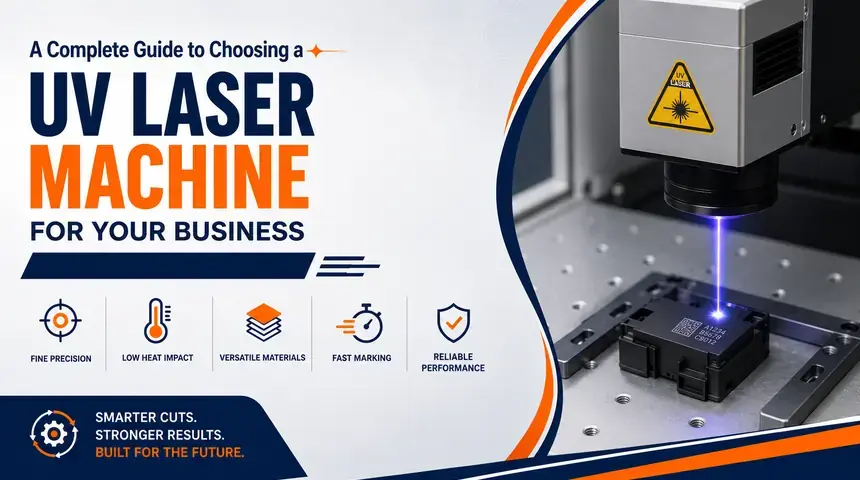
A UV laser marking machine uses an ultraviolet laser beam to create permanent marks on suitable material surfaces. Its shorter wavelength allows the laser energy to interact precisely with many materials.
The machine can create text, logos, serial numbers, barcodes, QR codes, symbols, and detailed graphics. CNC control and specialized software allow manufacturers to program marking designs and reproduce them consistently across production batches.
UV laser marking is especially useful for applications where fine detail and controlled surface interaction are important.
Why Choose UV Laser Marking Technology?
One of the main advantages of UV laser technology is its ability to produce detailed marks with relatively low thermal impact in suitable applications. Excessive heat can affect certain sensitive materials by causing discoloration, deformation, or unwanted surface changes.
UV lasers can provide precise marking while helping reduce these effects when the machine is correctly configured. This makes the technology useful for applications involving plastics, glass, coatings, electronics, and other suitable materials.
Identify Your Material
The first step in choosing a UV laser marking machine is understanding the materials you need to mark. Different materials respond differently to ultraviolet laser energy.
Common applications can include plastics, glass, ceramics, films, coated materials, electronic components, and certain metals. Before purchasing a machine, manufacturers should test representative samples to determine the required marking quality, contrast, speed, and settings.
Material compatibility should always be confirmed with the machine supplier.
Determine the Required Laser Power
Laser power affects marking speed, depth, and overall processing capability. However, higher power is not automatically better for every application.
For delicate products or highly detailed markings, the required power may differ from applications that require deeper or faster marking. Select laser power according to your materials, marking requirements, production volume, and desired results.
Choosing the appropriate power can help balance performance, quality, and operating costs.
Consider Marking Precision
Precision is essential when products contain small characters, intricate graphics, QR codes, or compact identification information.
When comparing UV laser marking machines, evaluate resolution, positioning accuracy, beam quality, and repeatability. A suitable machine should consistently reproduce the programmed design while maintaining clear and readable marks.
High precision is particularly valuable for electronics, medical products, small components, and products with limited marking space.
Evaluate Marking Speed
Production volume should influence your choice. A small business producing customized products may prioritize flexibility and detail, while a high-volume manufacturer may require faster marking cycles.
Compare the machine's marking speed with your expected workload. Remember that actual speed can vary depending on material, marking size, pattern complexity, laser settings, and required quality.
A good machine should provide an appropriate balance between speed and marking quality.
Check the Working Area
The working area determines the size and number of products that can be processed during each setup. Businesses should select a marking area based on their product dimensions and production workflow.
A larger working area may be useful for multiple components or larger products, while a smaller area can be practical for compact applications. Choosing the right configuration can help reduce repositioning and improve production efficiency.
Review Software and CNC Control
Software is an important part of modern laser marking. User-friendly software allows operators to create, import, edit, and manage marking designs.
Check whether the machine supports the file formats and design tools your business uses. Features for variable data, serial numbering, barcode generation, QR codes, and logo marking can be particularly useful for industrial applications.
CNC control also helps ensure accurate positioning and repeatable marking.
Consider Automation Requirements
Automation can improve productivity by reducing repetitive manual operations. Depending on production requirements, businesses may consider features such as automated positioning, rotary attachments, conveyor integration, or other material-handling solutions.
Not every manufacturer needs advanced automation. The right choice depends on production volume, available workspace, operator requirements, and future expansion plans.
Evaluate Machine Reliability
A laser marking machine may become an important part of daily production, so reliability should be carefully considered. Look for a machine designed for your expected operating conditions and production workload.
Manufacturers should also ask about component quality, expected service requirements, cooling systems, maintenance schedules, and recommended operating procedures.
Reliable equipment can help reduce unexpected interruptions and support consistent production.
Consider Maintenance and Technical Support
After-sales support is an important part of a laser machine investment. Before purchasing, ask about installation, operator training, preventive maintenance, spare parts, troubleshooting, and technical assistance.
A supplier that provides dependable support can help manufacturers resolve issues efficiently and maintain machine performance. Proper maintenance can also help preserve marking accuracy and extend equipment life.
Compare Total Cost and Long-Term Value
Price should not be the only factor when selecting a UV laser marking machine. Manufacturers should consider the complete cost of ownership, including machine price, electricity consumption, maintenance, replacement components, software, training, and service.
A machine that offers better reliability, precision, and productivity may provide greater long-term value than a lower-priced alternative. Evaluate how the equipment can support your production goals and future business growth.
Applications of UV Laser Marking Machines
UV laser marking machines can support a wide range of industrial applications. Electronics manufacturers may use them for components, connectors, and identification codes. Medical and pharmaceutical businesses can use suitable systems for product identification and traceability.
Other applications include automotive components, plastic products, glass items, electrical equipment, packaging, consumer products, and industrial parts. The exact application depends on the material and machine configuration.
Why Choose Paratech Industries?
Paratech Industries offers reliable industrial laser solutions, including UV and fiber laser marking machines, online laser marking machine, customised laser machine, fiber laser cutting machine, CO₂ cutting and engraving machine, handheld laser welding machines and specialised jewellery laser systems. With a focus on precision, machine quality, application-specific configurations and dependable after-sales support, Paratech Industries helps businesses choose suitable laser technology based on their materials, production volume, automation needs and marking requirements.
Conclusion
In order to UV laser mark, one must have a good understanding of one’s materials, requirements, volume, precision, speed, working area, software, degree of automation, and long-term cost. One should naturally integrate the machine into their production process. The right machine should deliver the result desired while fitting cohesively into the manufacturing process.
With the right context, controlling the interaction of the laser with the surface can provide great precision and detail. This makes UV laser marking an attractive option for many applications.
Paratech Industries can provide all the equipment for efficient marking. They also provide all the necessary configuration to help their clients industrial laser solutions. Paratech has the solutions for the new demands of modern manufacturing.
FAQs
What is a UV laser marking machine?
It uses ultraviolet laser technology to create precise and permanent marks on suitable materials.
What materials can UV lasers mark?
UV lasers can mark suitable plastics, glass, ceramics, coatings, electronics, and other materials.
How much laser power do I need?
Power depends on the material, marking speed, marking depth, and specific production requirements.
Can UV lasers create QR codes?
Yes, UV laser marking machines can create QR codes, barcodes, serial numbers, logos, and detailed graphics.
Why is supplier support important?
Reliable installation, training, maintenance, spare parts, and technical support can help maintain machine performance.