
Benefits of Handheld Laser Welding Machines for Industrial Applications
Introduction
Industrial manufacturing is constantly evolving to meet demands for higher productivity, better quality, and greater operational efficiency. Traditional welding methods such as TIG and MIG welding have served industries well for decades, but many manufacturers are now adopting advanced laser technologies to improve production processes.
Among these innovations, handheld laser welding machines have gained significant attention for their flexibility, speed, and precision.
Unlike conventional welding systems that often require extensive operator experience and significant post-processing, handheld laser welders offer a more efficient solution for joining metal components while maintaining exceptional weld quality.
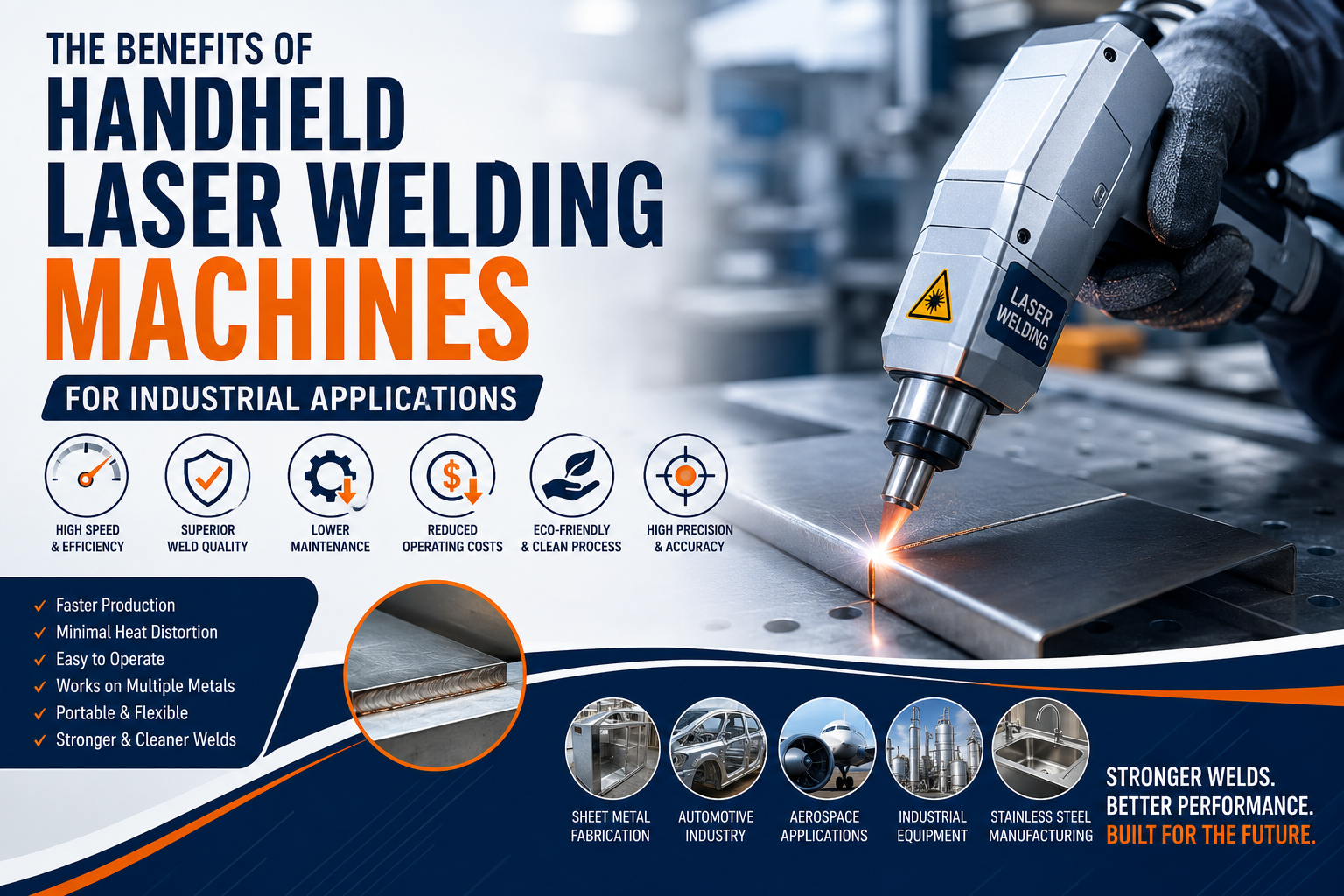
From sheet metal fabrication and automotive manufacturing to aerospace engineering and industrial equipment production, handheld laser welding machines are transforming how businesses approach welding operations. Modern handheld laser welders offer faster welding speeds, reduced heat input, and easier operation compared to many traditional welding methods.
What Is a Handheld Laser Welding Machine?
A handheld laser welding machine uses a high-powered laser beam to join metal materials together.
The operator controls a lightweight handheld welding head that directs concentrated laser energy onto the welding area.
Unlike traditional welding processes that rely on electrical arcs and larger heat zones, laser welding focuses energy precisely where it is needed, creating strong, clean welds with minimal thermal impact. Laser welding is a non-contact process that requires relatively little maintenance and can weld a wide range of metals, including stainless steel, aluminum, and copper.
Why Industries Are Switching to Handheld Laser Welding
Manufacturers today face increasing pressure to:
- Improve productivity
- Reduce production costs
- Minimize defects
- Maintain consistent quality
- Accelerate delivery timelines
Handheld laser welding helps address these challenges while providing greater flexibility across multiple industrial applications.
High Welding Speed Improves Productivity
One of the most significant advantages of handheld laser welding machines is speed.
Traditional TIG welding often requires slower processing and additional finishing work. Handheld laser welders can operate several times faster than conventional welding methods, helping manufacturers increase throughput and reduce production bottlenecks.
For manufacturers handling large production volumes, faster welding directly translates into:
- Increased output
- Reduced labor hours
- Improved production efficiency
- Faster project completion
Superior Weld Quality
Weld quality plays a critical role in product performance and customer satisfaction.
Handheld laser welding machines produce:
- Smooth weld seams
- Consistent weld penetration
- Minimal spatter
- Cleaner finishes
- High-strength joints
Because laser energy is highly concentrated, welds often require little or no additional polishing or finishing, reducing post-processing requirements.
Reduced Heat-Affected Zone
Traditional welding methods generate substantial heat that can affect surrounding materials.
Excessive heat often leads to:
- Warping
- Distortion
- Material stress
- Additional rework
Handheld laser welding creates a much smaller heat-affected zone (HAZ), helping preserve the integrity of the workpiece and reducing thermal deformation.
This advantage is especially valuable when working with:
- Thin metal sheets
- Precision components
- Stainless steel
- Aluminum parts
Easier Operation and Faster Training
One challenge many manufacturers face is the shortage of highly skilled welders.
Handheld laser welding systems are generally easier to learn than traditional TIG welding processes.
Modern handheld systems feature intuitive controls that allow operators to achieve high-quality welds with less training time. New operators can often become productive much faster than with conventional welding techniques.
This helps manufacturers:
- Reduce training costs
- Improve workforce flexibility
- Address skilled labor shortages
- Increase operational efficiency
Lower Post-Processing Requirements
Many traditional welding processes require extensive finishing work after welding.
Common post-processing activities include:
- Grinding
- Polishing
- Surface finishing
- Rework
Laser welding produces cleaner seams and more precise joints, reducing the amount of secondary processing required. Reduced post-processing contributes to higher productivity and lower production costs.
Increased Flexibility on the Shop Floor
Handheld laser welding machines provide mobility that stationary welding systems cannot offer.
Their portable design allows operators to:
- Weld large structures
- Access confined areas
- Perform on-site repairs
- Work on oversized assemblies
This flexibility makes handheld laser welders suitable for a wide range of industrial environments. Portable laser welding systems can operate effectively in tight spaces and on components that are difficult to move under fixed welding equipment.
Improved Precision for Complex Components
Industrial products increasingly require precision manufacturing.
Handheld laser welding provides exceptional accuracy, making it ideal for:
- Precision engineering
- Stainless steel fabrication
- Medical equipment
- Electronics enclosures
- Aerospace components
The focused laser beam allows operators to create fine, controlled welds while minimizing the impact on surrounding materials.
Cost Savings Over Time
Although laser welding equipment may require a higher initial investment, many businesses achieve long-term savings through:
- Faster production cycles
- Reduced labor costs
- Less material waste
- Lower rework rates
- Reduced finishing requirements
These operational efficiencies often result in a strong return on investment for manufacturers adopting laser welding technology.
Versatility Across Multiple Metals
Modern handheld laser welding machines can process various metal materials, including:
- Stainless steel
- Carbon steel
- Aluminum
- Copper
- Galvanized steel
This versatility allows manufacturers to use a single system across multiple production applications. Fiber laser welding technology is widely used for welding stainless steel, aluminum, copper, and even dissimilar metals.
Common Industrial Applications
Sheet Metal Fabrication
Laser welding is widely used for producing enclosures, cabinets, panels, and structural assemblies.
Automotive Manufacturing
Manufacturers use laser welding for body components, brackets, battery enclosures, and precision assemblies.
Aerospace Components
The aerospace industry relies on laser welding for lightweight structures and high-precision components.
Stainless Steel Products
Handheld laser welders are particularly effective for stainless steel fabrication due to their precision and reduced heat distortion.
Industrial Equipment Manufacturing
Machinery manufacturers use laser welding to improve production efficiency and weld quality.
Supporting Industry 4.0 Manufacturing
As manufacturers embrace Industry 4.0 initiatives, handheld laser welding aligns well with modern production goals.
Benefits include:
- Improved process consistency
- Higher efficiency
- Better quality control
- Reduced waste
- Increased automation readiness
Laser welding technology continues to play an important role in advanced manufacturing environments where productivity and precision are critical.
Why Choose Paratech Industries for Handheld Laser Welding Solutions
At Paratech Industries, we provide advanced handheld laser welding machines designed to meet the demands of modern manufacturing and fabrication operations.
Our laser welding solutions offer:
- High-speed welding performance
- Exceptional precision
- Reduced heat distortion
- Industrial-grade reliability
- User-friendly operation
- Support for multiple metal types
Whether you're involved in fabrication, automotive manufacturing, stainless steel processing, engineering, or industrial production, our laser welding systems help improve productivity while delivering superior weld quality.
Conclusion
Handheld laser welding machines are transforming industrial welding by providing faster processing speeds, superior weld quality, reduced heat distortion, and greater operational flexibility. As manufacturers continue seeking ways to improve productivity and reduce costs, laser welding technology offers a powerful solution for modern production environments.
From sheet metal fabrication and automotive manufacturing to aerospace and industrial engineering, handheld laser welding machines help businesses achieve higher efficiency, better product quality, and stronger competitive advantages.
Frequently Asked Questions
What is a handheld laser welding machine?
A handheld laser welding machine uses a focused laser beam to join metal components with high precision and minimal heat distortion.
Is handheld laser welding faster than TIG welding?
Yes. Handheld laser welding is often several times faster than traditional TIG welding, helping manufacturers improve productivity.
What materials can be welded using a handheld laser welder?
Common materials include stainless steel, carbon steel, aluminum, copper, and galvanized steel.
Does laser welding reduce post-processing?
Yes. Laser welding typically produces cleaner welds with less spatter, reducing the need for grinding and polishing.
Which industries benefit most from handheld laser welding?
Automotive, aerospace, sheet metal fabrication, industrial equipment manufacturing, electronics, and stainless steel processing industries commonly use handheld laser welding technology.
Why choose Paratech Industries for laser welding solutions?
Paratech Industries offers reliable handheld laser welding systems that help manufacturers improve productivity, achieve high-quality welds, and reduce operational costs.