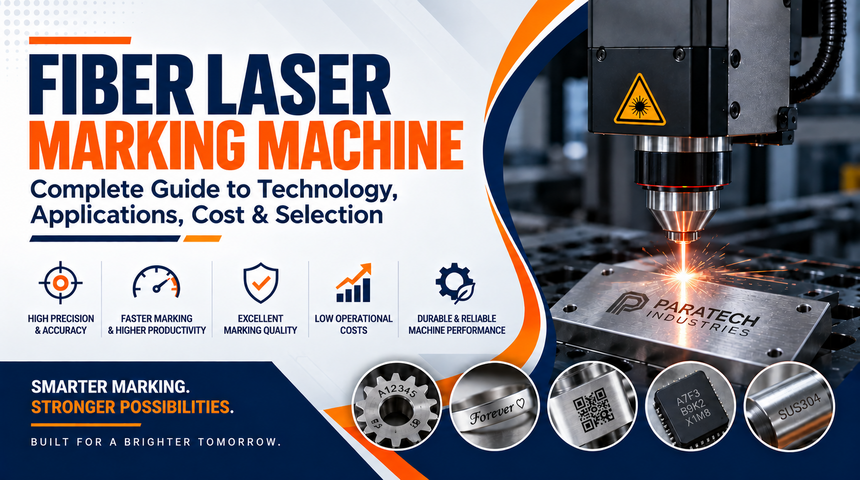
Fiber Laser Marking Machine: Complete Guide to Technology, Applications, Cost & Selection
Introduction
A fiber laser marking machine is an industrial system used to create permanent marks on metal and selected non-metal surfaces. It is widely used for logos, serial numbers, barcodes, QR codes, product identification, traceability, engraving, and decorative marking. Unlike ink printing or mechanical engraving, laser marking uses a focused beam of light to alter the surface without requiring inks, plates, or frequent tool replacement for many manufacturers.
For manufacturers, choosing the right fiber laser marking machine requires more than comparing wattage and price. Laser source type, marking speed, lens size, software, material, production volume, and the required marking depth all affect the final result. This guide explains the technology, applications, cost factors, and key selection criteria.
What Is a Fiber Laser Marking Machine?
A fiber laser marking machine uses a fiber laser source to generate an infrared beam, around 1064 nm, which is directed onto a workpiece through a galvanometer scanning system and focusing lens. The concentrated laser energy interacts with the material to produce a visible mark.
Depending on the settings and material, the process can create annealing marks, surface color changes, engraving, etching, or coating removal. Fiber lasers are particularly effective on metals such as stainless steel, aluminum, brass, copper, titanium, and various industrial alloys. Some plastics and coated materials can also be processed, although results depend on their composition.
How Does Fiber Laser Marking Technology Work?
The laser source produces the beam, while the control system determines how that beam moves across the workpiece. Galvanometer mirrors position the beam, and an F-theta lens focuses it across the marking field.
Operators control parameters such as laser power, marking speed, frequency, hatch spacing, and focus. These settings determine how much energy reaches the surface and therefore influence contrast, depth, heat input, and overall quality.
A standard fiber laser is often suitable for straightforward metal identification. MOPA fiber lasers provide greater pulse-width control and can be advantageous for color marking on stainless steel, high-contrast marking on anodized aluminum, certain plastics, and other applications requiring finer thermal control.
Common Applications
Fiber laser marking machines are used across manufacturing because they produce permanent, high-resolution identification.
Automotive manufacturers use them for part numbers, serial numbers, logos, and traceability codes. Electronics manufacturers mark connectors, housings, switches, and components. Engineering and hardware businesses use fiber lasers for tools, bearings, shafts, fasteners, and machine parts.
Jewellery manufacturers use laser systems for names, dates, logos, patterns, and detailed personalization on suitable metals. Medical-device manufacturers may use permanent identification and traceability marks where material compatibility and process validation requirements are met.
Another major application is barcode and QR-code marking. Laser-generated codes can provide durable identification throughout a product's life, making them useful for inventory control, traceability, and automated inspection.
Fiber Laser Marking vs. Fiber Laser Cutting
Fiber laser marking machine and Fiber Laser Cutting machine use laser technology but serve different purposes. Fiber laser marking changes or removes a thin layer of the material to create permanent logos, serial numbers, barcodes, and detailed designs, usually without cutting through the workpiece. Fiber laser cutting, on the other hand, uses higher laser power to completely penetrate and separate metal sheets, plates, or components into specific shapes. The right technology depends on whether you need to identify or decorate a surface or physically cut the material.
Fiber Laser Power: 20W, 30W, 50W, or 100W?
Power should be selected according to the application rather than simply choosing the highest available wattage.
A 20W or 30W machine can suit general marking, personalization, jewellery, and small-part applications. A 50W system can provide greater productivity and stronger engraving capability. Higher-power systems, such as 100W models, can be useful for demanding production, faster processing, or deeper engraving.
However, higher wattage does not automatically mean better marking. Beam quality, source characteristics, lens selection, scanning performance, and parameter optimization are equally important.
How Much Does a Fiber Laser Marking Machine Cost?
The cost varies substantially according to power, laser source, scanner, lens, enclosure, rotary attachment, automation, software, and manufacturer.
Entry-level systems cost less because they use simpler configurations and fewer features. Industrial machines with higher-power sources, enclosed workstations, vision systems, conveyors, rotary axes, or automated loading cost more.
When comparing quotations, look beyond the machine's headline price. Consider warranty, installation, training, replacement components, software support, safety equipment, and after-sales service. A cheaper machine can become expensive if downtime or poor technical support affects production.
Key Factors When Choosing a Machine
First, identify the materials you need to mark. A machine optimized for stainless steel may not deliver the same results on every plastic or reflective metal.
Second, determine the required marking depth and production speed. If you only need serial numbers and logos, a standard configuration may be sufficient. Deep engraving or high-volume production may require more power and optimized optics.
Third, check the laser source and scanner specifications. Reliable components can influence consistency, service life, and marking quality.
Fourth, consider the marking area. A larger lens provides a larger field but can affect spot size and achievable detail. If you mark cylindrical products such as rings, tubes, or pens, a rotary axis may be important.
Finally, evaluate software, operator safety, ventilation, maintenance requirements, training, warranty, and technical support.
Benefits of Fiber Laser Marking
Fiber laser marking offers several advantages in production. It produces permanent marks with high precision and can process detailed graphics, small text, barcodes, and serial numbers. It does not require conventional inks or physical marking tools, reducing consumables.
The non-contact process reduces mechanical wear on tooling. With suitable automation, laser marking can be integrated into production lines for repeatable identification and traceability.
Is Fiber Laser Marking Right for Your Business?
A fiber laser marking machine is a strong option when you need permanent, precise marking on compatible metals and selected other materials. The best system is not necessarily the most powerful or expensive model. It is the machine whose laser source, power, optics, software, working area, and accessories match your production requirements.
Before purchasing, test your real materials and representative designs whenever possible. Sample testing can reveal whether you need standard fiber or MOPA technology, which power level is appropriate, and whether your required speed and contrast are achievable.
Conclusion
Fiber laser marking technology has become an important solution for modern product identification, personalization, engraving, and traceability. Its precision, speed, permanence, and low consumable requirements make it suitable for automotive, electronics, jewellery, and engineering applications.
To select the right fiber laser marking machine, start with the material and marking objective, then compare power, laser source, optics, marking area, speed, automation, software, safety, service, and total ownership cost. For businesses looking for reliable laser marking solutions, Paratech Industries offers fiber laser marking and other industrial laser machines for a wide range of manufacturing applications.
Frequently Asked Questions
What is a fiber laser marking machine?
A fiber laser marking machine uses a focused laser beam to create permanent marks on metals and selected non-metal materials.
What materials can a fiber laser mark?
Fiber lasers are commonly used for stainless steel, aluminum, brass, copper, titanium, and various metal alloys. Some plastics and coated materials can also be marked.
What fiber laser power should I choose?
20W and 30W machines suit general marking, while 50W and higher-power machines are better for faster processing and deeper engraving.
Is fiber laser marking permanent?
Yes. Properly applied laser marks are highly durable and resistant to wear, making them suitable for identification, serial numbers, barcodes, and traceability.
How much does a fiber laser marking machine cost?
The price depends on laser power, source, marking area, optics, software, automation, accessories, and other machine specifications.