
Future Innovations in 3D Laser Marking Technology
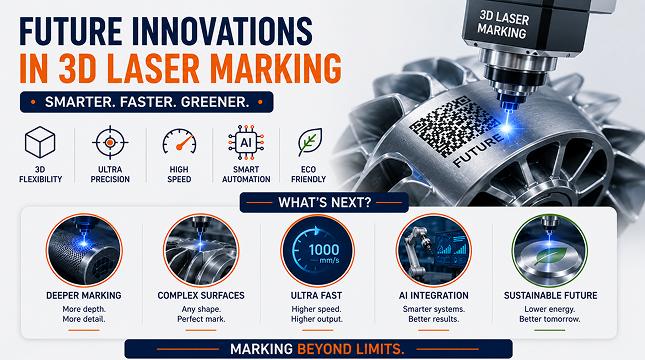
The Paratech Industry is evolving rapidly, and 3D laser marking technology is at the forefront of this transformation. As industries demand greater precision, faster production, and permanent product identification, laser marking systems continue to become more intelligent, efficient, and versatile.
From artificial intelligence to Industry 4.0 integration, the future of 3D laser marking promises exciting advancements that will improve productivity, reduce costs, and expand application possibilities. In this article, we explore the key innovations shaping the future of 3D laser marking technology.
What Is 3D Laser Marking?
3D laser marking is an advanced marking process that uses a laser beam with dynamic focus control to engrave or mark flat, curved, uneven, and complex surfaces. Unlike traditional laser marking systems, 3D technology automatically adjusts the focal distance during marking, ensuring consistent quality across varying surface heights.
This technology is widely used in industries such as automotive, aerospace, medical devices, electronics, jewelry, and industrial manufacturing.
Artificial Intelligence (AI) Integration
Artificial intelligence is becoming an essential part of modern manufacturing, and laser marking is no exception.
Future AI-powered systems will be able to:
- Automatically detect product orientation
- Adjust laser parameters in real time
- Reduce operator intervention
- Identify marking defects instantly
- Optimize engraving speed and quality
AI will make laser marking systems more intelligent, minimizing human error while improving production efficiency.
Smarter Industry 4.0 Connectivity
The future of manufacturing lies in connected factories.
Modern 3D laser marking machines are expected to integrate seamlessly with:
- Industrial IoT platforms
- ERP software
- MES systems
- Production monitoring dashboards
- Cloud-based quality control systems
This connectivity allows manufacturers to monitor machine performance remotely, analyze production data, and schedule predictive maintenance.
Improved Dynamic Focus Technology
One of the biggest innovations is the continuous improvement of dynamic focus control.
Future systems will offer:
- Higher marking accuracy
- Faster autofocus adjustments
- Better performance on irregular surfaces
- Increased marking depth consistency
- Improved engraving on complex geometries
This advancement will benefit industries producing highly detailed components.
Faster High-Speed Laser Processing
Manufacturers always seek higher productivity.
Future laser systems will feature:
- Higher scanning speeds
- Faster galvo scanners
- Improved beam control
- Reduced cycle times
- Better energy efficiency
These improvements will significantly increase production capacity without sacrificing marking quality.
Enhanced Precision for Micro Marking
As electronic devices become smaller, manufacturers require extremely precise marking solutions.
Future 3D laser marking technology will enable:
- Ultra-fine text
- Tiny serial numbers
- High-resolution QR codes
- Precision barcode engraving
- Micro-component identification
This innovation is especially valuable for electronics, semiconductor, and medical device manufacturers.
Better Compatibility with Advanced Materials
Manufacturers are increasingly using new materials, including:
- Carbon fiber composites
- Titanium alloys
- Medical-grade stainless steel
- Engineering plastics
- Ceramic materials
Future laser systems will include optimized settings for these materials, producing cleaner and more durable markings with minimal thermal impact.
Green and Energy-Efficient Manufacturing
Sustainability is becoming a priority across industries.
Future 3D laser marking systems will focus on:
- Lower power consumption
- Reduced maintenance requirements
- Longer laser source lifespan
- Minimal waste generation
- Elimination of inks and chemicals
Since laser marking is already a non-contact and chemical-free process, future innovations will make it even more environmentally friendly.
Advanced Vision Systems
Machine vision technology is rapidly improving.
Future laser marking machines will include cameras capable of:
- Automatic part recognition
- Position correction
- Surface inspection
- Mark verification
- QR code readability checks
These intelligent inspection systems will improve quality assurance while reducing production errors.
Robotic Automation Integration
Automation continues to reshape manufacturing.
Future laser marking solutions will work alongside:
- Robotic arms
- Automated conveyors
- Pick-and-place systems
- CNC machines
- Production robots
This integration enables fully automated production lines with minimal manual handling, increasing efficiency and consistency.
Cloud-Based Monitoring and Remote Diagnostics
Manufacturers increasingly require remote access to equipment performance.
Future systems will provide:
- Live production monitoring
- Performance analytics
- Software updates
- Remote troubleshooting
- Predictive maintenance alerts
Cloud connectivity reduces downtime and helps manufacturers maximize machine uptime.
Improved Security and Anti-Counterfeiting
Counterfeit products remain a major challenge across many industries.
Future laser marking technology will support:
- Encrypted QR codes
- Invisible laser markings
- Unique product identifiers
- Digital traceability
- Secure authentication systems
These features help manufacturers protect their products and strengthen brand trust.
Increased Customization and Personalization
As customer demand for customized products grows, manufacturers need flexible marking systems.
Future 3D laser marking machines will make it easier to create:
- Personalized product branding
- Custom logos
- Decorative engravings
- Variable data marking
- Limited-edition product designs
This capability is particularly valuable for jewelry, consumer goods, promotional products, and luxury items.
Industries That Will Benefit Most
Future innovations in 3D laser marking will have a significant impact on industries such as:
- Automotive manufacturing
- Aerospace engineering
- Medical device production
- Electronics manufacturing
- Tool and die manufacturing
- Industrial machinery
- Consumer products
- Packaging and labeling
- Jewelry and luxury goods
Why Businesses Should Invest in Future-Ready 3D Laser Marking
Investing in advanced 3D laser marking technology provides long-term benefits, including:
- Higher production efficiency
- Improved marking accuracy
- Permanent product identification
- Better traceability
- Reduced operating costs
- Enhanced product quality
- Increased automation capabilities
- Greater flexibility for future manufacturing needs
As manufacturing continues to embrace digital transformation, businesses equipped with modern laser marking systems will be better positioned to remain competitive.
Conclusion
The future of 3D laser marking technology is driven by innovation, automation, and intelligent manufacturing. Advancements in artificial intelligence, Industry 4.0 connectivity, machine vision, robotics, cloud monitoring, and sustainable production are transforming how manufacturers mark and identify products.
Companies that adopt these next-generation technologies can improve efficiency, ensure consistent quality, strengthen product traceability, and meet the growing demands of modern manufacturing. As industries continue to evolve, 3D laser marking will remain an essential technology for precision, reliability, and long-term success.
Frequently Asked Questions (FAQs)
What is the future of 3D laser marking technology?
The future includes AI-powered automation, Industry 4.0 integration, robotic systems, advanced vision inspection, cloud monitoring, and improved precision for complex applications.
Which industries benefit the most from 3D laser marking?
Automotive, aerospace, medical devices, electronics, industrial manufacturing, jewelry, and consumer goods industries benefit from its precision and durability.
Is 3D laser marking environmentally friendly?
Yes. It is a clean, non-contact process that eliminates the need for inks, solvents, and chemicals while producing minimal waste.
How does AI improve laser marking systems?
AI optimizes laser parameters, detects defects, automates adjustments, improves quality control, and reduces operator intervention.
Why is 3D laser marking important for Industry 4.0?
It enables connected manufacturing through real-time data sharing, automated workflows, predictive maintenance, and seamless integration with smart factory systems.