
Handheld Fiber Laser Welding vs Traditional Welding: Which Is Better?
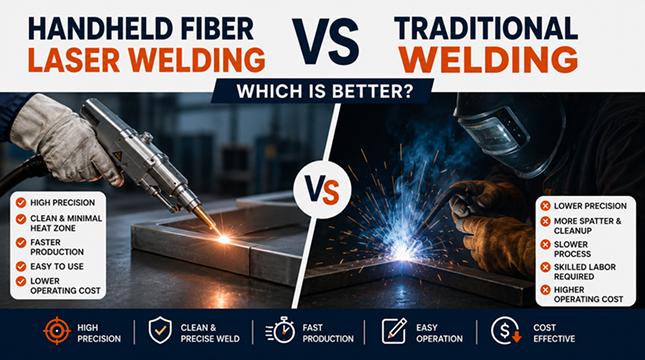
Introduction
Welding plays an important role in modern manufacturing, fabrication, automotive production, machinery, and metalworking. For many years, traditional welding methods such as MIG, TIG, and stick welding have been widely used to join metal components.
However, advances in laser technology have introduced faster and more precise alternatives. A handheld fiber laser welding machine uses a concentrated laser beam to join metal parts with high accuracy and controlled heat input.
This has led many manufacturers to ask an important question: Is handheld fiber laser welding better than traditional welding?
The answer depends on the specific application, materials, production volume, required weld quality, available budget, and operator requirements. Understanding the differences between the two approaches can help businesses make a more informed decision.
What Is Handheld Fiber Laser Welding?
Handheld fiber laser welding uses a high-energy fiber laser to create a concentrated heat source at the welding point. The handheld welding gun allows operators to move the laser along the joint and weld different shapes and components.
The technology is commonly used for materials such as:
- Stainless steel
- Carbon steel
- Mild steel
- Aluminum
- Galvanized steel
- Other compatible metals
Because the laser beam is highly focused, the process can provide precise welding with relatively low heat input in suitable applications.
What Is Traditional Welding?
Traditional welding includes several established welding methods, such as MIG, TIG, and stick welding. These processes generally use an electrical arc to generate heat and melt the base material, with or without filler material, to create a joint.
Traditional welding remains widely used because of its versatility, established processes, and suitability for many heavy-duty applications.
However, it can involve higher heat input, more spatter in certain processes, and additional finishing requirements depending on the application.
Handheld Fiber Laser Welding vs Traditional Welding
Welding Speed
One of the main advantages of fiber laser welding is its potential for high welding speed.
A concentrated laser beam can deliver energy directly to the welding area, allowing fast processing in suitable applications. This can help manufacturers increase production output and reduce processing time.
Traditional welding methods can also provide good productivity, but welding speed may vary depending on the process, material, thickness, joint design, and operator skill.
Winner: Handheld Fiber Laser Welding for many suitable high-speed fabrication applications.
Weld Precision
Precision is another important difference.
Fiber laser welding produces a highly focused heat source, allowing manufacturers to control the welding area more precisely. This can be beneficial for applications requiring clean and accurate welds.
Traditional welding can also produce high-quality welds, particularly with skilled operators, but the wider heat distribution of an arc-based process can make precision more challenging in some applications.
Winner: Handheld Fiber Laser Welding when highly focused heat and precise welding are important.
Heat Input and Distortion
Traditional arc welding can introduce significant heat into the surrounding material. Depending on the material and welding conditions, this may result in distortion or a larger heat-affected area.
Laser welding concentrates energy in a smaller area. This can reduce heat input and help minimize distortion in suitable applications.
Lower distortion can be particularly valuable when welding thin sheets or components where dimensional accuracy and appearance matter.
Winner: Handheld Fiber Laser Welding for applications where controlled heat input and lower distortion are important.
Weld Appearance
The appearance of a finished weld can be an important consideration in products such as stainless steel equipment, metal furniture, kitchen equipment, and visible fabrication components.
Handheld fiber laser welding can produce clean and consistent welds when the machine is properly configured and operated.
Traditional welding can also provide strong and attractive welds, but some processes may produce more spatter or require additional grinding and finishing.
Winner: Handheld Fiber Laser Welding for many applications where a clean weld appearance is important.
Post-Welding Finishing
Traditional welding may require additional work after welding, such as grinding, polishing, cleaning, or removing spatter.
Depending on the application and welding parameters, fiber laser welding can reduce the amount of post-welding finishing required.
This can help save processing time and labor, particularly for products where surface appearance is important.
Winner: Handheld Fiber Laser Welding in applications where reduced finishing is achievable.
Operator Skill Requirements
Traditional welding relies significantly on operator skill. Experienced welders are often required to maintain consistent travel speed, arc length, torch angle, and heat input.
Handheld laser welding can simplify certain welding operations because machine parameters can be controlled more consistently. However, operators still require appropriate training in machine operation, process setup, and laser safety.
Therefore, laser welding does not eliminate the need for skilled operators, but it can reduce some of the process variability associated with manual welding.
Advantage: Handheld Fiber Laser Welding for applications where process consistency and ease of operation are priorities.
Flexibility
Traditional welding processes are highly versatile and have been adapted to a wide range of materials, thicknesses, joint designs, and working environments.
Handheld fiber laser welding also offers flexibility, particularly for sheet metal and fabrication applications. The handheld welding gun makes it possible to work on different shapes and components.
However, the suitability of either method depends heavily on the specific application.
Result: Depends on the Application
Energy Efficiency
Fiber laser systems can offer efficient energy transfer because the laser beam delivers concentrated energy to the welding area.
Traditional arc welding systems also have established energy-efficient configurations, but energy consumption varies according to the process, equipment, and operating conditions.
For businesses focused on reducing operating costs, actual energy consumption should be evaluated based on the specific machine and production process rather than relying only on general comparisons.
Potential Advantage: Handheld Fiber Laser Welding
Maintenance Requirements
Both technologies require regular maintenance.
Traditional welding equipment may require maintenance of torches, cables, electrodes, wire-feeding systems, and other components depending on the welding process.
Laser welding systems require attention to protective lenses, cooling systems, optics, nozzles, and other machine components.
The maintenance requirements will depend on the machine design and operating conditions.
Result: Depends on the Equipment and Application
Initial Investment
One of the biggest considerations for businesses is equipment cost.
Traditional welding equipment is generally available in a wide range of configurations and price levels, making it accessible for many businesses.
A handheld fiber laser welding machine may require a higher initial investment. However, businesses should also consider productivity, labor requirements, finishing time, energy use, maintenance, and long-term operating costs.
Therefore, the lowest purchase price does not necessarily mean the lowest overall cost.
Winner: Traditional Welding for lower initial equipment investment in many cases.
When Should You Choose Handheld Fiber Laser Welding?
A handheld fiber laser welding machine may be a strong option if your business needs:
- Faster welding for suitable applications
- Precise and consistent welds
- Lower heat input
- Reduced material distortion
- Cleaner weld appearance
- Less post-welding finishing
- Flexible handheld operation
- Improved production efficiency
It can be particularly useful for businesses involved in sheet metal fabrication, stainless steel products, machinery, automotive components, metal furniture, kitchen equipment, and other manufacturing applications.
When Is Traditional Welding Still a Better Choice?
Traditional welding remains an excellent option for many applications.
It may be more suitable when:
- Initial equipment investment needs to remain low
- Existing welding infrastructure is already established
- Heavy-duty welding is required
- The application is well suited to MIG, TIG, or stick welding
- Welding is performed in environments where laser equipment may not be practical
- The business already has experienced traditional welders and established processes
The right technology should always be selected according to the actual production requirements.
Why Choose Paratech Industries for Laser Welding Solutions?
Paratech Industries provides industrial laser solutions for modern manufacturing and metal processing requirements. Its range of laser technology includes solutions for laser marking, cutting, engraving, welding, and cleaning.
For businesses considering a handheld fiber laser welding machine, choosing an experienced laser equipment provider can make the transition to laser welding easier.
Before selecting a machine, businesses should evaluate their materials, material thickness, production volume, welding speed, weld quality requirements, and operating environment. These factors help determine the most suitable machine configuration.
Paratech Industries can help businesses explore laser welding solutions based on their specific manufacturing and application requirements.
How to Decide Between Laser Welding and Traditional Welding
There is no single welding method that is best for every business. The right choice depends on your production requirements.
Choose handheld fiber laser welding when speed, precision, reduced heat input, clean welds, and production efficiency are major priorities.
Choose traditional welding when lower initial investment, established processes, heavy-duty applications, or existing welding infrastructure are more important.
For businesses considering an upgrade, testing both methods using actual production materials can provide valuable information before making a final investment.
Conclusion
So, which is better: handheld fiber laser welding or traditional welding?
For many modern metal fabrication and manufacturing applications, handheld fiber laser welding can provide significant advantages in terms of welding speed, precision, heat control, weld appearance, and production efficiency. However, traditional welding remains a reliable and versatile solution for many applications and may offer a lower initial investment.
The best choice depends on your material, thickness, production volume, weld requirements, budget, and long-term business goals.
By carefully comparing these factors and testing the technology with your actual materials, you can select a welding solution that supports productivity, quality, and long-term manufacturing efficiency.
Frequently Asked Questions
Is handheld fiber laser welding better than traditional welding?
It can be better for applications requiring high speed, precision, controlled heat input, clean welds, and reduced finishing. Traditional welding may remain more suitable for certain heavy-duty or cost-sensitive applications.
Is laser welding faster than MIG welding?
In suitable applications, fiber laser welding can achieve higher welding speeds than some conventional processes. Actual speed depends on material, thickness, joint design, machine power, and operating conditions.
Which welding method produces cleaner welds?
Handheld fiber laser welding can produce clean and consistent welds with less spatter in suitable applications. Traditional welding results depend on the welding process, material, parameters, and operator skill.
Is fiber laser welding suitable for stainless steel?
Yes. Fiber laser welding machines are commonly used for stainless steel applications when the equipment is correctly configured for the material and thickness.
Is traditional welding cheaper than laser welding?
Traditional welding equipment generally has a lower initial investment. However, businesses should compare total operating costs, including labor, energy, consumables, finishing, maintenance, and productivity.