How Deep Can a Fiber Laser Marking Machine Engrave?
Introduction
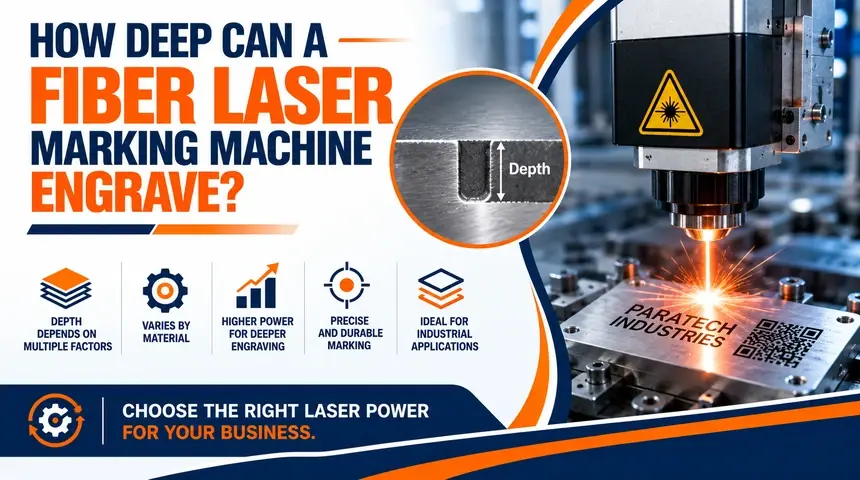
Fiber laser marking machines are widely used for permanent marking, engraving, serial numbers, QR codes, logos, and product identification on metal components. But one common question manufacturers ask is: how deep can a fiber laser marking machine engrave? The answer is not a single fixed number. Engraving depth depends on laser power, material type, marking speed, frequency, focus, beam characteristics, and the number of passes used. Paratech Industries also notes that the required marking depth is an important factor when selecting a laser marking solution.
What Is Deep Engraving With a Fiber Laser?
Deep engraving is different from ordinary surface marking. Standard laser marking generally creates a visible mark by changing or removing a very thin layer of the material. Deep engraving removes more material to create a physical recess that can be felt on the surface.
A fiber laser can gradually remove material by making multiple passes over the same design. The final depth depends on how much material is removed during each pass and how the machine parameters are configured. For this reason, deep engraving usually takes considerably longer than surface marking.
How Deep Can a Fiber Laser Engrave?
There is no universal maximum depth for every fiber laser marking machine. In practical industrial applications, fiber lasers can produce shallow engraving measured in fractions of a millimetre, while specialised high-power systems and multiple-pass processes can achieve considerably deeper engraving.
For example, published specifications for 20W, 30W and 50W fiber marking systems commonly show approximate depth ranges that vary significantly by material and machine configuration. One manufacturer lists approximately 0.02 to 0.15 mm on stainless steel for 20W, 0.05 to 0.30 mm for 30W, and 0.1 to 0.5 mm for 50W, while aluminium and mild steel can achieve greater depths under suitable conditions.
These figures should be treated as application examples rather than guaranteed results for every machine. Actual engraving depth should always be confirmed through material testing.
How Laser Power Affects Engraving Depth
Laser power has a major influence on deep engraving. A higher-power fiber laser can deliver more energy to the material, allowing material removal to occur more efficiently. For applications requiring deeper engraving, manufacturers may consider 50W, 100W or higher-power configurations depending on the material and production requirements.
However, choosing the highest available power is not always the best solution. If the requirement is mainly serial numbers, QR codes, logos or identification marks, a lower-power fiber laser may provide the required result more efficiently. Paratech recommends selecting a machine according to the material, marking type, required depth, speed, production volume and other application requirements. See the laser marking machine range for more information.
Material Makes a Big Difference
The material being engraved has a direct impact on achievable depth. Stainless steel, mild steel, aluminium, brass, copper, titanium and other compatible metals respond differently to laser energy. Surface finish, hardness, reflectivity and thermal properties can also influence the engraving process.
For example, a parameter that produces a good deep mark on mild steel may not produce the same result on stainless steel or aluminium. Paratech lists stainless steel, mild steel, aluminium, brass, copper, titanium, gold, silver, platinum, carbide and selected plastics among materials that can be considered for laser marking, with suitability depending on the actual laser configuration and material.
Number of Passes Controls the Depth
One of the most important factors in deep laser engraving is the number of passes. Instead of trying to remove the required depth in a single pass, the machine can repeatedly scan the same design. Each pass removes additional material until the desired depth is reached.
Multiple-pass engraving provides better control, but it also increases processing time. For this reason, a manufacturer producing thousands of parts may need to balance engraving depth against cycle time. A deeper mark may be useful for dies, tools, industrial components or parts exposed to wear, while a shallow mark is often sufficient for product identification.
Speed, Frequency and Focus Matter
Laser power is only one part of the equation. Marking speed also affects how much energy is delivered to a particular area. Slower processing can increase material removal, while frequency and pulse settings influence the interaction between the laser and the material.
Focus is equally important because the laser beam needs to be concentrated correctly on the workpiece. An incorrectly focused beam can reduce engraving quality and make it difficult to achieve consistent depth. Paratech's laser marking process includes setting parameters such as power, speed, frequency and focus according to the material and application.
Deep Engraving vs Surface Marking
Surface marking is generally intended for identification, branding and traceability. It can include serial numbers, product codes, QR codes, barcodes, logos and other information. Deep engraving goes further by physically removing material to create a recessed mark.
If your objective is simply permanent product identification, deep engraving may not be necessary. If the marking needs to remain visible after polishing, machining, wear or repeated handling, deeper engraving may be worth considering. The correct depth should therefore be determined by the application's durability requirements rather than by laser power alone.
When Do You Need a Higher-Power Fiber Laser?
A higher-power fiber laser can make sense when your application requires deeper engraving, faster material removal or higher production throughput. It can be particularly useful for industrial components, tools, dies, moulds and applications where multiple passes with a lower-power machine would take too much time.
If your production process has unusual dimensions, specific depth requirements or automation needs, a standard machine may not be sufficient. In such cases, a Customised Laser Marking Machine can be configured around the product, marking area, power requirements and production workflow. Paratech also provides customised capabilities such as fixtures, tailored power and rotary indexing.
Can Fiber Lasers Engrave Curved or Complex Surfaces?
Yes, but the machine configuration becomes important. Conventional fiber laser marking systems are generally designed around a defined marking plane, while complex or varying surface heights may require a suitable 3D laser marking solution.
A 3D Laser Marking Machine can be considered for curved, uneven and three-dimensional components. Paratech specifically identifies curved surfaces, complex parts, moulds, tools and jewellery designs as applications for 3D laser marking.
Fiber Laser vs UV Laser for Engraving Depth
Fiber lasers are commonly considered for industrial metal marking and engraving, while UV lasers are often selected when fine, detailed or specialised marking is required. UV systems can be useful for sensitive materials and applications where controlled, fine marking is more important than deep material removal.
If your requirement involves fine text, detailed graphics, electronics or certain plastics, a UV Laser Marking Machine may be more appropriate. The right technology depends on the material and required result rather than simply choosing the laser with the highest power.
What About High-Volume Deep Engraving?
For high-volume manufacturing, engraving depth must be considered together with production speed. If every component requires several passes, cycle time can increase significantly. Businesses producing large quantities may therefore benefit from optimised parameters, higher laser power or automation.
An Online Laser Marking Machine can integrate laser marking into a production line, allowing products to be marked as they move through an automated process. This can support continuous marking, high-speed coding and batch traceability.
How to Choose the Right Fiber Laser for Deep Engraving
Before purchasing a machine, define the required material, engraving depth, marking area, production quantity and acceptable cycle time. Then determine whether the application needs one pass or multiple passes. Testing the actual workpiece is particularly important because two materials that appear similar can behave differently under laser processing.
For general industrial marking requirements, a Fiber Laser Marking Machine can provide a practical solution for permanent marking and engraving on compatible materials. Paratech's fiber laser solutions are intended for applications including serial numbers, QR codes, barcodes, logos, identification and traceability.
Frequently Asked Questions
How deep can a fiber laser engrave?
The achievable depth depends on power, material, speed, focus, frequency and number of passes. Many industrial applications work within fractions of a millimetre, while specialised systems can achieve greater depths.
Is 50W enough for deep engraving?
A 50W fiber laser can be suitable for many deep engraving applications, but the actual result depends on the material and required depth. Testing is recommended before final machine selection.
Does higher wattage always mean deeper engraving?
Not necessarily. Higher power can improve material removal, but speed, focus, frequency, beam quality, material properties and processing strategy also affect the final depth.
Can fiber lasers engrave stainless steel deeply?
Yes. Fiber lasers are widely used for stainless steel marking and engraving. The achievable depth depends on the machine configuration and selected parameters.
Is deep engraving suitable for production lines?
It can be, but deep engraving may require multiple passes and therefore more processing time. For high-volume production, the engraving requirement should be balanced with cycle time and automation.