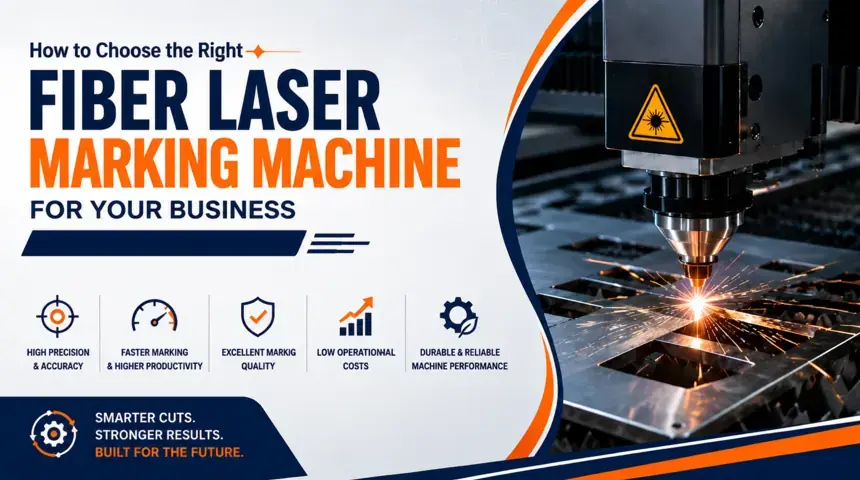
How to Choose the Right Fiber Laser Marking Machine for Your Business
Introduction
Choosing the right fiber laser marking machine is an important decision for businesses looking to improve product identification, traceability, branding, and manufacturing efficiency. With multiple options available in the market, selecting a machine based only on price or specifications can create challenges in achieving the desired marking quality and production performance.
At Paratech Industries , we understand that every business has unique marking requirements based on materials, production volume, application type, and quality expectations. Whether you need precise serial number marking, barcode identification, logo engraving, or industrial component marking, selecting the right fiber laser solution plays a key role in achieving reliable and consistent results.
Understand Your Marking Application
Start by defining exactly what you need to mark. Fiber laser machines can create logos, serial numbers, barcodes, QR codes, batch numbers, graphics, and traceability information. A company marking simple text on steel parts will have different requirements from a jewellery manufacturer creating detailed patterns or a factory marking thousands of components daily. Understanding the application helps you avoid buying a machine that is either underpowered or unnecessarily expensive.
Check Material Compatibility
Fiber lasers are mainly used for metals and selected industrial plastics. They work effectively on stainless steel, aluminium, brass, copper, titanium, mild steel, coated metals, and many engineering components. Marking results can vary because of material composition, surface finish, coating, colour, and desired contrast.
A supplier such as Paratech Industries can evaluate samples and recommend a suitable configuration based on real marking trials instead of assumptions.
Select the Right Laser Power
Laser power is an important specification. Common options include 20W, 30W, 50W, and higher-powered systems. A 20W or 30W machine may be enough for standard surface marking, logos, serial numbers, and general identification.
However, more power does not always mean better results. The correct choice depends on material, engraving depth, production speed, and quality requirements. Buying excessive power can increase cost without creating meaningful value.
Evaluate Production Speed
Production volume should directly influence your machine selection. If you operate a high-volume production line, marking speed and cycle time are critical. Consider how many parts must be marked each hour, the size of the marking area, and whether the process is manual, semi-automatic, or automated.
Also review loading time, fixture design, operator movement, and software workflow because overall productivity depends on the complete process, not laser speed alone.
Choose the Correct Marking Area
Fiber laser systems are available with different lens sizes and marking fields. A smaller marking area usually provides better energy concentration and fine detail, while a larger field provides more coverage for bigger components.
Avoid selecting the largest marking area unless your production requires it. The lens and field size influence marking intensity, resolution, and performance, so your supplier should recommend the right combination based on actual component dimensions.
Consider Engraving Depth and Finish
Some businesses need only visible surface identification, while others require deeper engraving that remains readable after wear, coating, or harsh industrial use. Deep engraving generally requires more power and additional cycle time.
If your products need black marking, high-contrast results, annealing, or decorative finishing, discuss these needs before purchasing. Testing is one of the best ways to confirm whether the proposed machine can deliver the finish your business expects.
Review Software and Automation Options
The software should be simple enough for operators to create serial numbers, import logos, generate barcodes, update batch information, and manage recurring jobs efficiently.
Check compatibility with common design formats and confirm whether the system supports variable data, database connectivity, barcode generation, PLC communication, scanners, conveyors, or automation when required.
User-friendly software reduces training time and production errors. Businesses planning future automation should choose a machine that can integrate with their expanding manufacturing process.
Examine Build Quality
Do not judge a machine only by its headline specifications. Review the laser source, scanner head, controller, power supply, workstation, electrical components, safety enclosure, and mechanical structure.
Stable construction helps maintain focus and consistent marking quality during regular production. An industrial machine should also perform reliably in the environment where it will operate.
A better-built system may have a higher initial price, but lower downtime, improved consistency, and longer service life can generate stronger returns.
Consider Safety Requirements
Laser safety is essential. Depending on the machine and application, businesses may need protective enclosures, interlocks, emergency switches, warning indicators, extraction systems, and appropriate operator protection.
Ask your supplier how the system is configured for safe use and what precautions employees must follow. Proper training should cover machine operation, focusing, parameter settings, maintenance, and safety procedures.
A safe, well-trained production environment protects employees and reduces the risk of incorrect machine handling.
Evaluate Technical Support
After-sales service is an important part of machine ownership. Even reliable equipment may eventually require parameter guidance, software assistance, replacement parts, maintenance, or troubleshooting.
Choose a supplier that provides installation support, operator training, technical consultation, and spare-part availability. Paratech Industries can help businesses evaluate marking requirements and select practical solutions based on production goals.
Strong service support can reduce downtime and help operators maintain consistent output over the machine’s working life.
Calculate Total Cost of Ownership
Do not compare machines using purchase price alone. Consider electricity, maintenance, replacement components, training, downtime risk, expected lifespan, productivity, and support availability.
Fiber laser systems usually require relatively low maintenance, but machine quality and service still influence long-term ownership costs. A slightly higher initial investment may deliver better speed, precision, reliability, and support, ultimately reducing the cost per marked component.
This approach helps protect your investment and supports reliable daily production performance.
Conclusion
Choosing the right fiber laser marking machine requires a balance of application requirements, material compatibility, power, marking area, speed, engraving depth, software, build quality, safety, support, and total cost of ownership.
The best machine is not always the most powerful or expensive option. It is the system that consistently produces the required results while supporting your production targets.
Before purchasing, test your components, discuss future production needs, and compare suppliers based on technical capability and after-sales support. With guidance from Paratech Industries, businesses can select a fiber laser marking solution that improves efficiency, identification, traceability, and long-term manufacturing performance.
FAQs
What materials can a fiber laser marking machine mark?
Fiber lasers commonly mark stainless steel, aluminium, brass, copper, titanium, mild steel, coated metals, and selected industrial plastics.
Is a 20W fiber laser enough for industrial marking?
Yes, 20W can handle many standard surface-marking applications. Higher power may be better for deeper engraving or faster production.
How do I choose the right marking area?
Select a field that fits your largest regular component while maintaining the required detail, contrast, and marking intensity.
Do fiber laser marking machines require maintenance?
They generally require limited maintenance, but regular cleaning, inspection, correct operation, and timely technical service remain important.
Why choose Paratech Industries?
Paratech Industries can support machine selection by evaluating materials, marking applications, production requirements, and suitable configurations for practical industrial use.