
How UV Laser Marking Machines Create Permanent Marks
Introduction
Modern manufacturing requires clear, accurate, and durable product identification. Manufacturers use markings for logos, serial numbers, barcodes, QR codes, technical information, and traceability. Traditional printing and labeling methods can fade, peel, or become difficult to read over time. UV laser marking machines provide a modern alternative by creating precise and permanent marks directly on suitable material surfaces.
UV laser technology is particularly valuable for applications that require fine details, clean results, and controlled marking with limited thermal impact. By selecting the correct machine and operating parameters, manufacturers can achieve consistent marks while maintaining the appearance and quality of their products.
What Is UV Laser Marking?
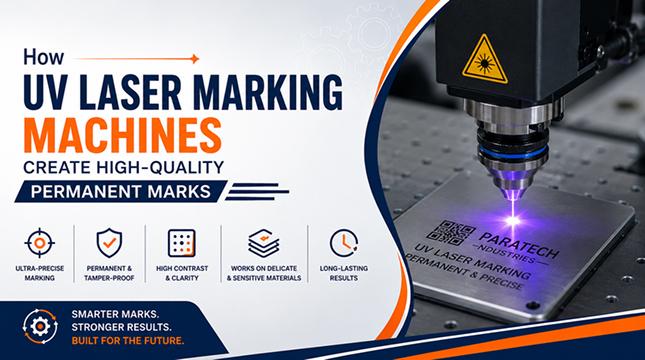
UV laser marking is a non-contact marking process that uses an ultraviolet laser beam to create permanent changes on a material surface. The shorter wavelength of UV laser technology allows the beam to interact precisely with many materials.
A UV laser marking machine can create text, logos, serial numbers, barcodes, QR codes, symbols, and detailed graphics. CNC control and marking software allow manufacturers to program designs and reproduce them accurately across multiple products.
How Do UV Laser Marking Machines Create Permanent Marks?
UV laser marking works by directing concentrated ultraviolet laser energy onto a selected area of the material. Depending on the material and settings, the laser can create a color change, surface modification, or other controlled marking effect.
Because the process is digitally controlled, the machine can apply the same design repeatedly with accurate positioning. The resulting mark becomes part of the material surface rather than relying on an additional label or ink layer. This can provide better durability for many industrial applications.
High Precision for Detailed Marking
One of the main advantages of UV laser marking is its ability to produce fine and detailed marks. The focused laser beam can create small characters, thin lines, intricate patterns, and compact identification codes.
Low Thermal Impact
Some materials can be sensitive to excessive heat during marking. Conventional processes or unsuitable laser settings may cause discoloration, deformation, or unwanted surface changes.
UV laser technology can provide a lower thermal impact for many applications because its shorter wavelength interacts efficiently with the surface. This makes it useful for certain plastics, electronics, glass, coatings, and other sensitive materials. Proper testing and parameter selection remain essential because every material reacts differently.
Permanent and Durable Identification
Durability is particularly valuable for components that require long-term traceability. Serial numbers, product codes, and other identifiers can help businesses track products through manufacturing, storage, distribution, and service.
Consistent Marking Quality
Manufacturing quality depends heavily on repeatability. Manual marking can result in differences in position, size, depth, or readability. UV laser marking machines use programmed digital files, helping reproduce the same marking accurately.
Consistent marks support professional product presentation and make identification easier during inspection. Automated marking can also reduce repetitive manual tasks, allowing operators to focus on monitoring equipment and checking finished products.
Applications Across Industries
UV laser marking technology can be used in several industries. Electronics manufacturers may use it for components, connectors, circuit-related products, and identification codes. Medical and pharmaceutical businesses can use suitable laser marking systems for product identification and traceability.
Other applications include automotive components, electrical products, consumer goods, packaging, plastics, glass, and industrial parts. The exact application depends on the material, marking requirements, machine configuration, and production environment.
Benefits of UV Laser Marking
UV laser marking provides several advantages for manufacturers seeking reliable product identification. It supports precise marking, permanent results, repeatable production, and flexible digital design control.
The process can also reduce dependence on consumables such as inks, labels, and printing materials. Because marking is non-contact, there is no physical marking tool rubbing against the product surface. This can help reduce mechanical damage and support clean production processes.
Manufacturers can change digital designs quickly when product information or identification requirements change. This flexibility is useful for customized products, multiple product versions, and smaller production batches.
Factors to Consider Before Choosing a UV Laser Marking Machine
Manufacturers should evaluate their application carefully before purchasing a machine. Material compatibility is one of the most important considerations because different materials respond differently to ultraviolet laser energy.
Laser power, marking speed, marking area, resolution, software, automation, and machine configuration should also match production requirements. Businesses should consider whether they need text, graphics, barcodes, QR codes, or highly detailed patterns.
Technical support and after-sales service are also important. Proper installation, operator training, maintenance, and troubleshooting support can help maintain machine performance and reduce production interruptions.
Why Choose Paratech Industries?
Paratech Industries provides industrial laser solutions designed to support modern manufacturing and precision marking applications. For manufacturers that require accurate, durable, and consistent identification, suitable UV laser technology can improve marking quality and production workflows.
Choosing the right machine depends on the material, application, production volume, marking requirements, and desired level of automation. Paratech Industries focuses on laser solutions that can help businesses meet changing manufacturing requirements.
With suitable UV laser marking technology, manufacturers can create detailed product information while maintaining consistency across production. This can support branding, traceability, quality control, and efficient identification processes.
Conclusion
UV laser marking machines provide manufacturers with a reliable way to create high-quality permanent marks. Their ability to produce fine details, consistent identification, and controlled marking makes them suitable for many modern manufacturing applications.
Compared with temporary labels or printed identification, laser marking can provide greater durability and reduce dependence on consumable marking materials. Its digital control also allows manufacturers to reproduce designs accurately and adapt marking information when required.
From electronics and medical products to automotive components, plastics, glass, and industrial parts, UV laser marking can support a wide range of applications. By selecting the appropriate laser power, software, and machine configuration, businesses can achieve results that match their material and production requirements.
Frequently Asked Questions
What makes UV laser marking permanent?
UV laser marking changes or modifies the material surface in a controlled way, creating identification that does not depend on separate labels or ink.
What materials can UV lasers mark?
Depending on the machine and application, UV lasers can mark plastics, glass, ceramics, coatings, electronics, and various other suitable materials.
Are UV laser marks resistant to wear?
UV laser marks can provide durable identification, although durability depends on the material, marking method, environment, and application.
Can UV laser marking create QR codes?
Yes. UV laser marking machines can create precise QR codes, barcodes, serial numbers, logos, and other digital identification.
Why choose Paratech Industries?
Paratech Industries provides industrial laser solutions designed to support precise marking, product identification, traceability, and modern manufacturing needs.