
Laser Welding Applications in the Automotive Industry | Paratech Industries
Introduction
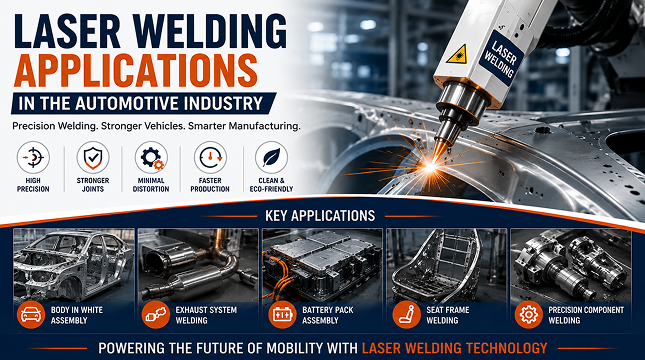
The automotive industry is constantly evolving to meet growing demands for lighter vehicles, improved fuel efficiency, enhanced safety, and faster production cycles. To achieve these goals, manufacturers rely on advanced manufacturing technologies that deliver exceptional precision and consistency. Among these innovations, laser welding has become one of the most important joining technologies in modern vehicle production.
Unlike conventional welding methods, laser welding produces narrow, deep welds with minimal heat distortion, making it ideal for manufacturing high-quality automotive components. From vehicle body structures and battery packs to exhaust systems and electric vehicle components, laser welding enables manufacturers to produce durable, lightweight, and reliable products while reducing production costs.
As vehicle designs become increasingly complex and automation continues to reshape manufacturing, laser welding has become a critical technology for automotive companies seeking higher productivity and superior product quality.
Why Laser Welding Is Essential in Modern Automotive Manufacturing
Automotive manufacturers operate in one of the world's most competitive industries, where precision, speed, and reliability directly impact profitability and customer satisfaction.
Traditional welding techniques often require multiple processing steps, generate excessive heat, and may cause distortion in thin metal components. Laser welding addresses these challenges by delivering concentrated energy to a small area, producing clean and highly accurate welds with minimal thermal impact.
This technology enables manufacturers to automate production lines, reduce material waste, improve structural integrity, and achieve consistent weld quality across thousands of components.
As the automotive industry shifts toward electric vehicles (EVs), lightweight materials, and smart manufacturing, laser welding has become even more valuable.
Understanding Laser Welding Technology
Laser welding uses a highly focused laser beam to melt and fuse metal components together. The concentrated beam creates a narrow weld with exceptional penetration while limiting heat transfer to surrounding materials.
The process can be fully automated using robotic systems, making it ideal for high-volume automotive production.
Compared to conventional welding methods, laser welding offers:
High welding speed
Exceptional precision
Minimal heat-affected zones
Reduced material distortion
Strong, clean welds
Excellent repeatability
Easy integration with robotic automation
These characteristics make laser welding particularly suitable for manufacturing modern vehicles that require both lightweight construction and high structural strength.
The Growing Role of Automation in Automotive Welding
Automotive manufacturers increasingly rely on automated production lines to improve consistency and productivity.
Laser welding integrates seamlessly with robotic systems, allowing manufacturers to perform complex welding operations without manual intervention.
Robotic laser welding systems provide precise positioning, repeatable weld quality, and continuous operation, enabling manufacturers to produce thousands of identical components with minimal variation.
Automation also improves workplace safety by reducing operator exposure to high temperatures and hazardous welding environments.
Applications of Laser Welding in the Automotive Industry
Laser welding supports nearly every stage of vehicle manufacturing. Its ability to join different materials with high precision makes it suitable for a wide range of automotive applications.
1. Body-in-White (BIW) Assembly
One of the most common uses of laser welding is in Body-in-White manufacturing.
The vehicle body structure consists of numerous steel and aluminum panels that must be joined accurately while maintaining structural integrity.
Laser welding provides:
High-strength joints
Excellent dimensional accuracy
Reduced panel distortion
Improved crash performance
Faster production speeds
Manufacturers use robotic laser welding systems to assemble vehicle frames efficiently while maintaining consistent weld quality.
2. Electric Vehicle Battery Pack Manufacturing
The rapid growth of electric vehicles has significantly increased the demand for precision laser welding.
Battery packs contain numerous delicate components that require highly accurate welds without damaging surrounding materials.
Laser welding is widely used for:
Battery cell connections
Battery module assembly
Busbar welding
Battery housing fabrication
Cooling plate welding
Because battery components are highly sensitive to heat, laser welding's low heat input helps protect critical electronic parts while ensuring reliable electrical connections.
3. Exhaust System Manufacturing
Automotive exhaust systems operate under extreme temperatures and constant vibration.
Laser welding creates strong, leak-proof joints that improve durability and corrosion resistance.
Applications include:
Exhaust pipes
Catalytic converter assemblies
Mufflers
Stainless steel tubing
Emission control components
The clean, precise welds also improve product appearance while minimizing post-processing requirements.
4. Transmission Components
Transmission systems contain precision-engineered parts that demand exceptional dimensional accuracy.
Laser welding enables manufacturers to join gears, shafts, housings, and transmission assemblies with minimal distortion.
The technology improves manufacturing precision while reducing machining and finishing operations.
5. Automotive Sensors and Electronic Components
Modern vehicles include hundreds of electronic sensors responsible for safety, navigation, engine management, and driver assistance systems.
Laser welding is commonly used for assembling:
Pressure sensors
Fuel injection components
Electronic housings
Radar modules
Camera enclosures
Control units
Its precision allows manufacturers to weld miniature components without damaging sensitive electronics.
6. Airbag Components
Vehicle safety systems require components that perform flawlessly under critical conditions.
Laser welding is widely used to manufacture:
Airbag inflators
Gas generators
Safety restraint components
The process ensures strong, reliable welds while maintaining the dimensional accuracy required for safety-critical parts.
7. Automotive Seat Frames
Seat frames require strong yet lightweight welded joints.
Laser welding produces durable welds while reducing overall component weight, supporting manufacturers' efforts to improve fuel efficiency and vehicle performance.
8. Fuel System Components
Laser welding is also used in manufacturing:
Fuel tanks
Fuel injectors
Fuel rails
Pump assemblies
Its precise heat control helps prevent deformation while producing leak-free joints essential for safety.
Laser Welding Supports Lightweight Vehicle Design
Reducing vehicle weight has become a major priority for automotive manufacturers.
Lighter vehicles consume less fuel, produce lower emissions, and improve battery range for electric vehicles.
Laser welding allows manufacturers to join advanced lightweight materials including:
High-strength steel
Stainless steel
Aluminum alloys
Titanium
Nickel alloys
Because laser welding produces narrow weld seams with minimal material deformation, manufacturers can design lighter structures without compromising strength.
Benefits of Laser Welding in Automotive Manufacturing
Higher Production Speed
Laser welding operates significantly faster than many conventional welding methods.
High-speed robotic systems enable continuous production while reducing manufacturing cycle times.
Superior Weld Quality
Laser welding produces consistent, high-strength welds with minimal defects.
The technology reduces common issues such as:
Porosity
Cracking
Excessive spatter
Distortion
This improves product reliability while lowering rejection rates.
Reduced Heat Distortion
The concentrated laser beam limits heat transfer to surrounding materials.
This minimizes:
Warping
Shrinkage
Material deformation
Residual stress
Reduced distortion decreases the need for secondary machining or straightening operations.
Lower Manufacturing Costs
Although laser welding systems require an initial investment, they often reduce long-term production costs through:
Faster manufacturing
Reduced labor
Lower material waste
Less rework
Improved automation
Higher equipment utilization
Over time, these efficiencies provide significant cost savings.
Improved Automation
Laser welding integrates easily with Industry 4.0 manufacturing environments.
Manufacturers can combine laser systems with:
Industrial robots
Vision inspection systems
Artificial Intelligence
IoT monitoring
Automated quality control
This enables fully connected smart factories with greater operational efficiency.
Laser Welding in Electric Vehicle Manufacturing
Electric vehicles represent one of the fastest-growing sectors in automotive manufacturing.
Laser welding plays a central role in EV production because many battery and electrical components require highly precise joining techniques.
Key EV applications include:
As EV production continues to expand worldwide, laser welding demand is expected to grow rapidly.
Comparing Laser Welding with Traditional Welding
This comparison demonstrates why laser welding has become the preferred solution for modern automotive manufacturing.
Future Trends in Automotive Laser Welding
The future of automotive production is closely linked with intelligent manufacturing technologies.
Several trends are driving continued adoption of laser welding:
AI-assisted welding optimization
Real-time weld quality monitoring
Machine vision integration
Fully autonomous robotic welding cells
Industry 4.0 connectivity
Advanced battery manufacturing
Increased use of lightweight alloys
Smart predictive maintenance
As manufacturers pursue greater efficiency and sustainability, laser welding will remain one of the industry's most important production technologies.
Why Choose Paratech Industries for Automotive Laser Welding Solutions?
At Paratech Industries, we provide advanced laser welding solutions designed to meet the demanding requirements of modern automotive manufacturing.
Our laser welding machines deliver exceptional precision, high-speed performance, and consistent weld quality for applications ranging from vehicle body assembly to electric vehicle battery production. Whether you require handheld laser welding systems for flexible operations or automated industrial solutions for high-volume manufacturing, we offer reliable equipment engineered for long-term performance.
Our team works closely with manufacturers to recommend the right laser technology based on production requirements, materials, and automation goals. With a commitment to innovation, quality, and customer support, Paratech Industries helps automotive businesses improve productivity, reduce manufacturing costs, and achieve superior welding results.
Conclusion
Laser welding has transformed automotive manufacturing by enabling faster production, stronger welds, improved precision, and greater automation. From conventional vehicles to next-generation electric vehicles, this technology supports the industry's pursuit of lighter, safer, and more efficient transportation solutions.
As automotive manufacturers continue investing in automation and advanced materials, laser welding will play an increasingly vital role in meeting future production demands. Businesses that adopt high-quality laser welding solutions today will be better positioned to improve efficiency, maintain product quality, and remain competitive in the rapidly evolving automotive market.
Frequently Asked Questions
Why is laser welding used in the automotive industry?
Laser welding provides high precision, faster production, minimal distortion, and strong welds, making it ideal for manufacturing automotive components.
Which automotive parts are commonly laser welded?
Laser welding is used for vehicle body panels, battery packs, exhaust systems, seat frames, transmission components, fuel systems, sensors, and electric vehicle assemblies.
Is laser welding suitable for electric vehicle manufacturing?
Yes. Laser welding is widely used in EV battery manufacturing, battery module assembly, busbar welding, motor production, and cooling system fabrication due to its precision and low heat input.
What materials can laser welding join in automotive manufacturing?
Laser welding can join stainless steel, carbon steel, aluminum, high-strength steel, titanium, and various specialized alloys commonly used in vehicle production.
How does laser welding improve manufacturing efficiency?
It increases production speed, reduces rework, minimizes heat distortion, supports robotic automation, lowers material waste, and improves overall product quality.
Why choose Paratech Industries for laser welding solutions?
Paratech Industries provides advanced laser welding machines engineered for precision, reliability, and industrial performance, helping automotive manufacturers improve productivity and achieve consistent, high-quality welding results.